
On this page
Fiddler AI is a control plane for enterprise AI agents, combining observability, evals, guardrails, and governance. On November 3, 2026, CrowdStrike announced an agreement to acquire Fiddler and to offer its capabilities through Falcon Observe.
If you use Fiddler to trace agents, that planned acquisition may affect your buying decision. Add a per-trace meter and a free tier that covers only guardrails, and it’s worth comparing other options.
- AI engineers on your agent
- Set up in minutes
- No credit card
We reviewed the 8 best Fiddler AI alternatives, from open-source trace stores and enterprise observability platforms to tools for testing changes against recorded agent sessions.
A Quick Overview of the Best Fiddler AI Alternatives
- Why look for alternatives: CrowdStrike’s pending acquisition creates uncertainty about Fiddler’s roadmap. Its Developer plan costs $0.002 per trace, while the Free plan covers guardrails rather than observability.
- Who should care: AI engineers and platform teams that need to trace production agents, assess their behavior, investigate failures, and test fixes before release.
- What to expect: 8 alternatives to Fiddler AI, from replay-based testing in Kitaru to an open-source trace store (Langfuse), an open-source evaluation framework (Evidently AI), eval-first platforms (Braintrust, LangSmith, Maxim AI) and enterprise control planes (Splunk, Datadog).
- Which Fiddler: The alternatives below mainly address agent observability, evaluation, and experiments. Fiddler’s monitoring for traditional ML models is a separate use case, partly covered here by Evidently AI, Splunk, and Datadog.
The Need for a Fiddler AI Alternative
1. Uncertainty Following CrowdStrike’s Planned Acquisition
CrowdStrike expects the Fiddler acquisition to close in Q4 of its fiscal 2027, subject to customary closing conditions. It also targets that quarter for Falcon Observe’s general availability. The announcement gives no details on how existing Fiddler contracts or support arrangements will be handled.
None of that means the product gets worse. However, the roadmap, the contract, and the support path are moving into a security platform. So teams that bought it as an engineering tool now need to re-evaluate their options.
2. Observability Costs Can Increase With Trace Volume
Fiddler’s Developer plan lists at $0.002 per trace. At that rate, 100,000 traces cost $200 and one million cost $2,000. Still, actual costs may differ based on contract terms, what counts as a billable trace, and any applicable usage allowances or discounts. The pricing page defines none of those.
A multi-turn agent can generate multiple traces if you instrument each turn as a separate trace. Tool retries and sub-agent calls can also appear as spans within an existing trace. Estimate spend using your expected billable trace count.
3. Teams Looking for Free Observability Must Look Beyond Fiddler’s Free Tier
Fiddler’s Free plan covers guardrails for hallucinations, toxicity, PII or PHI exposure, prompt injection, and jailbreak attempts. Unified AI observability, tests and experiments are listed under the paid Developer plan, as are custom evaluators, bring-your-own judge, RBAC and SSO. That is a valid packaging decision, but it means a small team looking for a no-cost trace store or local evaluation library should look at tools with an open-source core.
Evaluation Criteria
We assessed each Fiddler AI alternative against four criteria:
- Agent tracing and visibility: Can you follow an agent request through model calls, tools, retrieval, errors, latency, tokens, and cost to understand what happened? A trace is only useful when an engineer can reconstruct why the agent took an unexpected path.
- Evaluation of agent quality: Can the platform measure whether the agent completed the task correctly? We looked for deterministic checks, LLM-as-a-judge options, datasets, human review, and the ability to compare quality between versions.
- Root-cause analysis and debugging: When a production session fails, can a developer narrow the issue to a model call, tool call, prompt, retrieval result, evaluator, or infrastructure dependency? A useful UI doesn’t eliminate the need to investigate. It makes the evidence reachable.
- Replay, re-testing, and experimentation: Can a team reproduce a failure and test a change without causing the original side effects again? Most platforms can evaluate a dataset. Fewer can re-run the agent’s real code against a recorded session and show the baseline beside a candidate.
What are the Top Alternatives to Fiddler AI?
| Fiddler AI Alternative | Best For | Key Features | Pricing |
|---|---|---|---|
| Kitaru by ZenML Labs | Testing changes against recorded production sessions | • Recorded-tool replay • Cross-session analysis • Immutable cohorts • CI-gated experiments | • Free (Open source) • Paid plans start at $39/month |
| Splunk Agent Observability | Evals, guardrails, and tracing under one vendor | • Agent monitoring and evaluators • Signals detects 45 agent failure types | • Free plan • Paid pricing starts at $100/month, billed annually, for 1.2 million spans per year. |
| Langfuse | Teams that want to own their trace store | • OTLP endpoint • Agent graphs • Versioned datasets | • Free (Open source) • Paid plans start at $29/month |
| LangSmith | LangGraph and LangChain teams | • Engine investigates failures • Evaluator Calibration | • Free • Paid plans start at $39/seat/month |
| Evidently AI | Python-first AI evaluation and monitoring | • Test suites and reports • Data-quality and drift checks | Free and open source. Self-hosted. |
| Datadog Agent Observability | Existing Datadog users | • Insights with root cause and fix • Dataset-based experiments • Sensitive-data controls | • Free tier available • Pro starts at $160/month with an annual commitment |
| Maxim AI | Simulating conversations before release | • Scenario-based simulation • Node-level online evals | • Free (3 seats) • Paid plans start at $29/seat/month |
| Braintrust | Eval-first teams that gate merges on scores | • Add to dataset from production logs • Remote evals run your own code | • Free • Paid plans start at $249/month |
1. Kitaru by ZenML Labs
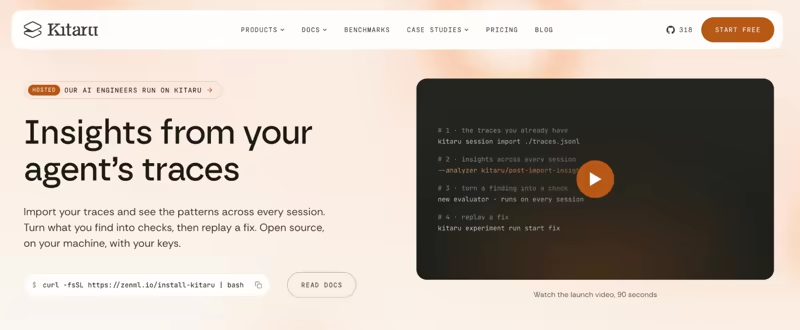
Kitaru is ZenML Labs’ open-source tool for turning production traces into investigations and regression tests. It can import traces from Langfuse, LangSmith, Braintrust, Logfire, Arize Phoenix, and MLflow. To replay a session, you need a runnable agent version. Recording adapters cover PydanticAI, LangGraph, the OpenAI Agents SDK, Mastra, and the Vercel AI SDK. The Claude Agent SDK adapter records one-shot queries.
Kitaru complements your trace store rather than replacing Fiddler’s live monitoring or guardrails.
Here’s how it works.
Feature 1. Read Every Session at Once Before You Open One
"""session_outcomes.py: how did this batch of sessions turn out?"""

from collections import Counter
from uuid import UUID

from kitaru.api_models.v1.insight import (
    CategoricalInsightData,
    CategoryValue,
    InsightInput,
)
from kitaru.client.api_client import KitaruAPIClient


async def analyzer(session_ids: list[UUID], **params) -> InsightInput:
    counts: Counter[str] = Counter()
    async with KitaruAPIClient() as client:
        for session_id in session_ids:
            session = await client.sessions.get(session_id)
            counts[session.status] += 1
    return InsightInput(
        name="session_outcomes",
        title="Session outcomes",
        data=CategoricalInsightData(
            values=[
                CategoryValue(label=status, value=count)
                for status, count in counts.items()
            ]
        ),
    )
Kitaru’s analyzers read a set of sessions and write insights such as how outcomes split, failed and repeated tool calls, cost concentrated in a few sessions, and model input that grows within a session.
The built-in kitaru/post-import-insights analyzer needs no model or API key. Each insight links to the supporting sessions and includes briefing prompts for coding assistants. It can run during imports, so engineers see patterns before opening individual traces.
Feature 2. Replay Your Real Agent Code Against Recorded Tool Calls

A replay in Kitaru re-executes a recorded session from the top with the original inputs, and a tool policy decides what each tool call receives.
For tools the adapter can intercept, a history policy returns a recorded result when the tool name and arguments match. If you leave the policy unset, Kitaru defaults to passthrough and invokes the live tool.
Likewise, on_miss handles calls that were never made in different ways: fail stops the replay, error_result hands the agent an error, and passthrough runs the live tool.
For a refund agent, configure the refund tool to use history with on_miss="fail" so matching calls use recorded results and unmatched calls stop the replay. Fiddler’s golden-dataset workflow runs your task function on cases drawn from production spans. If that task needs recorded tool responses, supply the fixtures or mocks in the task code.
Feature 3. Test One Change Across a Frozen Production Cohort

Once you identify a family of failures, Kitaru lets you place the affected sessions in a cohort and run an experiment with one override, maybe swap the model, replace the system or user prompt, or adjust model_params. Code changes need no override; register the new code as an agent version and point the run at it.
An experiment applies that change across an immutable cohort version, so a result that says 12 of 14 sessions improved stays checkable against exactly those 14 sessions. The regression suite guide takes this into CI: kitaru experiment run start ... --wait exits nonzero on failure. A bundled dashboard shows the paired traces, baseline next to replay.
Feature 4. Turn Expert Review Into Evaluator Calibration Data

Through the kitaru-investigation skill and the MCP review tools, your coding agent picks the sessions worth a reviewer’s time, asks one question per session, and highlights the evidence. The reviewer answers in context and gives each session a verdict of acceptable, problematic, or uncertain. Each answer becomes an annotation pinned to the exact evidence, down to a node, a JSON path, even a character range. That is a different experience from an annotation queue that puts a nested trace tree in front of a support lead.
Evaluators are checked against those annotations before they gate anything, and the sessions a reviewer marks problematic become the next regression cohort. Ten deterministic evaluators ship in kitaru-evaluator, and a separate typed judge package adds yes/no, choice, and score questions. There is no large judge catalog beyond those, and no assignment queues or multi-reviewer scoring.
Pricing
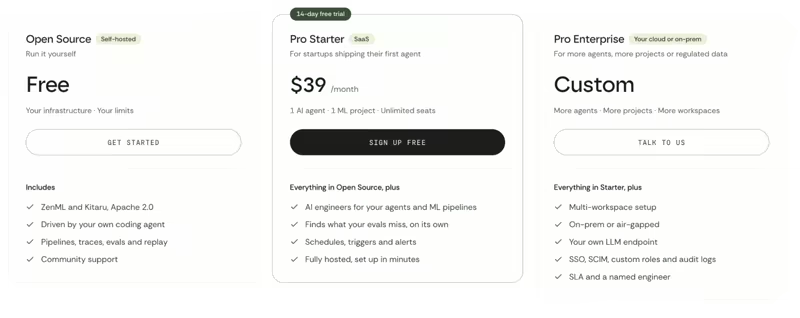
Kitaru is free to self-host under Apache 2.0. Imports, cohorts, evaluators, experiment runs, and replay on your own workers are unlimited. ZenML Pro is the paid tier that hosts both Kitaru and ZenML and has two cloud-hosted plans:
- Pro Starter: $39 per month
- Pro Enterprise: Custom pricing
Pros and Cons
Kitaru fits teams that already have production traces and need to turn failures into regression suites. It works on top of existing instrumentation instead of replacing it, and its self-hosted core is free. Plus, built-in features like cross-session analysis help you find repeated problems, while expert reviews and recorded-tool replay support tests against actual agent code.
However, it’s deliberately narrower than most tools in this list. It isn’t a live monitoring dashboard, guardrail service, or prompt playground. Replay requires runnable code registered as an agent version. There’s also no direct OpenTelemetry ingestion endpoint or Fiddler importer; teams must convert exports to Kitaru JSONL or write an importer.
2. Splunk Agent Observability
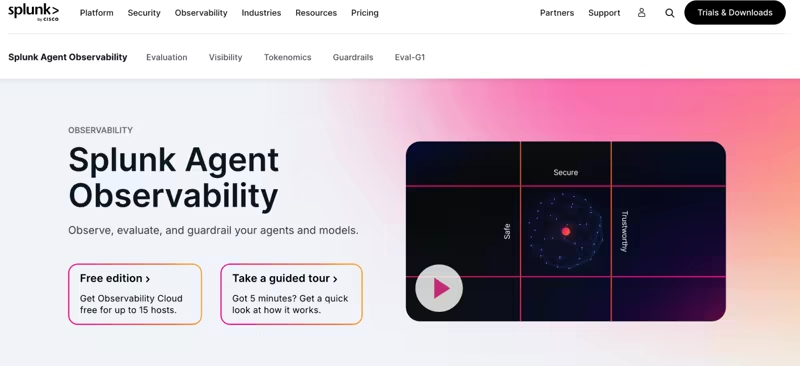
Splunk, formerly Galileo, is the closest like-for-like Fiddler alternative here, with production tracing, evaluators, and runtime guardrails. It’s especially relevant to teams already using Splunk Observability Cloud.
Features
- Inspect model calls, tools, retrieval steps, and conversation in one view. Splunk also tracks latency, tokens, and cost across agents and workflows, helping you locate and investigate expensive requests or identify the steps slowing down an agent.
- Evaluate production traffic with Eval-G1 or custom metrics. Its Auto-tune capability incorporates reviewers’ corrections into evaluator tuning, and you can apply trusted evaluation checks as runtime guardrails. Luna-3 models add enterprise evaluation options, too.
- Detects up to 45 types of agent behavior failures, including recurring tool errors and problematic execution paths, without opening every trace. The associated coding-assistant workflow helps engineers investigate issues and prepare fixes in their codebase.
- Use the experiments SDK to test prompt templates or application functions against evaluation data. Custom functions can include multiple agent steps, retrieval operations, and tool calls, allowing you to evaluate more than an individual LLM response.
Pricing
Comes with a free plan. Paid pricing starts at $100/month, billed annually, for 1.2 million spans per year.
Pros and Cons
Splunk combines monitoring, continuous evaluation, and runtime guardrails. Its Signals feature reduces manual trace review, and existing Splunk customers can connect agent behavior to application and infrastructure telemetry.
Pricing beyond the starting rate needs closer review, especially for evaluator usage, retention, and enterprise features. Luna-3 isn’t available on every plan, and the platform isn’t open source. Its experiments can execute application functions, but they do not provide Kitaru-style replay against recorded external tool results.
3. Langfuse
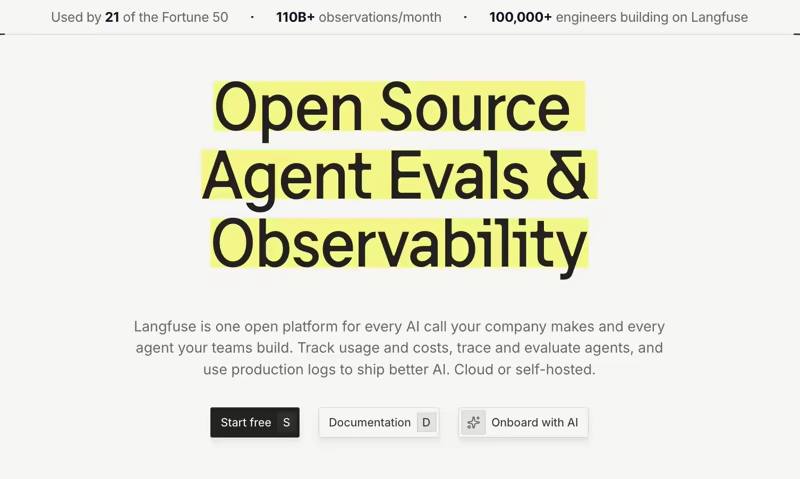
Langfuse is the open-source trace store in this list. It fits teams that want open-source agent tracing without abandoning hosted convenience.
Features
- Capture LLM calls, tool executions, retrieval operations, latency, token usage, and cost through native SDKs or Langfuse’s OTEL endpoint. Its agent graphs visualize multi-step workflows and repeated operations without requiring engineers to read every span.
- Store prompts centrally, track changes, and associate prompt versions with recorded traces. Reopen a recorded LLM generation in Langfuse’s playground, change the prompt or model, and inspect the new output without rerunning the entire agent.
- Run LLM-as-a-judge checks on live traces or offline datasets using your own model connections. Custom scores and annotation queues support decisions that need human review.
- Add observations to versioned datasets, including traces flagged during production review. Run experiments against these datasets through the SDK, compare scores between runs, and use the documented GitHub Action to check thresholds in CI.
Pricing
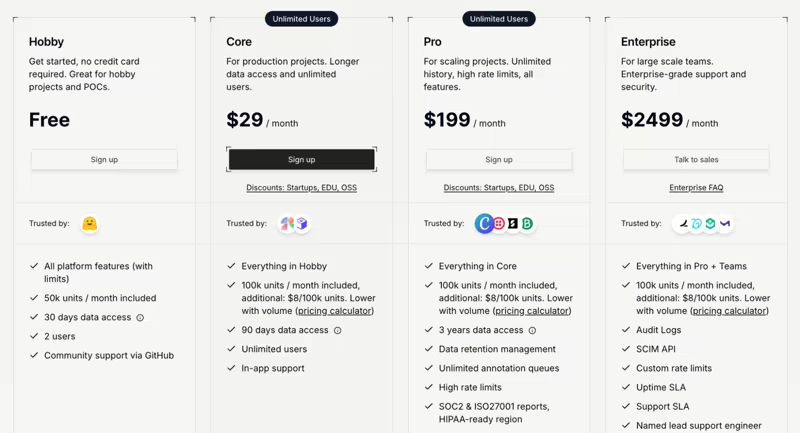
Langfuse is MIT-licensed and can be self-hosted for free. Hosted Hobby is free with 50,000 units per month and two users, followed by three paid plans:
- Core: $29 per month
- Pro: $199 per month
- Enterprise: $2,499 per month
Pros and Cons
Langfuse is a good fit for teams that want an open-source observability platform with tracing, prompt management, datasets, and evaluations in one place. Its OpenTelemetry support reduces dependence on framework-specific instrumentation, while the MIT-licensed core gives teams control of their trace storage.
However, self-hosting requires ClickHouse, PostgreSQL, Redis, and object storage. Its playground focuses on individual generations, while dataset experiments don’t reproduce recorded tool responses. Teams that need to reproduce complete agent failures can pair Langfuse with Kitaru, which imports Langfuse traces and uses them for replay-based testing.
4. LangSmith
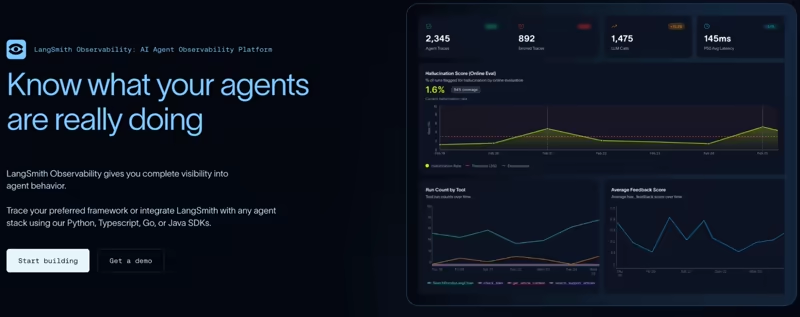
LangSmith is a Fiddler alternative for teams that build with LangChain and LangGraph. It supports tracing, monitoring, datasets, prompt tooling, human annotation queues, and online and offline evaluations.
Features
- Capture model calls, tools, retrieval, and intermediate steps through LangSmith’s SDK or OpenTelemetry. Its LangChain and LangGraph connections simplify tracing agents built with those frameworks.
- Scan production traces for recurring problems, group similar failures, and investigate their causes. With repository access, Engine can inspect source code, propose a fix, and open a pull request.
- Run code-based checks and LLM judges on datasets or live traces. Use annotation queues for expert review, and the Evaluator calibration workflow to compare automated judgments with human labels before depending on those scores.
- Convert production traces into datasets and test updated prompts, models, or functions. Regression tests, backtesting, pairwise comparisons, and summary metrics help teams spot quality changes.
Pricing
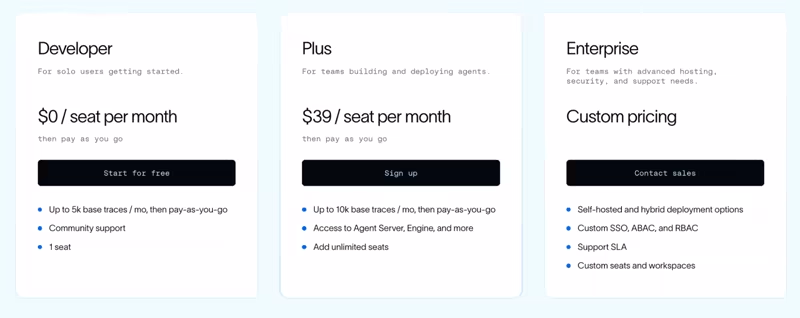
LangSmith offers a free Developer plan for one seat with 5,000 base traces a month, then pay as you go. Paid plans:
- Plus: $39 per seat per month
- Enterprise: Custom pricing
Pros and Cons
LangSmith is useful for LangChain and LangGraph teams that want tracing and evaluations in the same workflow. Its Engine feature connects failure investigation with source-code fixes, and human review helps calibrate scoring.
The trade-offs are pricing complexity and replay scope. Seats, trace volume, and Engine usage introduce separate costs. And while LangSmith supports historical dataset testing, its experiments don’t automatically reproduce the recorded tool responses from an earlier production session. Agents that modify external systems therefore need separately configured mocks or other controls during re-execution.
5. Evidently AI
Evidently AI is a Python-first evaluation and monitoring framework for LLM applications, agents, traditional ML models, data quality, and drift. It’s a good alternative to Fiddler AI when you want quality checks in Python, CI, or a locally controlled reporting workflow rather than in a complete agent-observability SaaS.
Features
- Use Evidently’s open-source library with more than 100 metrics for data and AI quality. Combine deterministic rules, statistical tests, classifiers, and LLM evaluations in reports or test suites, with conditional checks for acceptance criteria.
- Run checks on text, tabular data, embeddings, retrieval results, and predictive-model outputs. The same framework can assess RAG and agent quality alongside data drift and model performance.
- Execute checks in notebooks, scripts, or CI without a hosted service. Self-host Evidently’s UI service to get a monitoring dashboard, visualize results, and track changes over time.
Pricing
Evidently’s Apache 2.0 Python library and self-hosted platform are free to use. Evidently has discontinued its hosted Evidently Cloud service.
Pros and Cons
Evidently suits teams that want explicit Python tests for both generative AI and traditional ML. Its open-source library supports both gen AI and traditional machine learning, making it relevant to teams replacing Fiddler’s broader ML monitoring capabilities. Tests can also run alongside existing development and CI workflows.
However, Evidently is primarily an evaluation and monitoring framework, not a dedicated agent-debugging platform. It does not provide the same trace-first investigation workflow as LangSmith or Langfuse; you must supply the agent execution environment, and replaying production sessions against recorded tool results requires a separate replay mechanism.
6. Datadog Agent Observability
Datadog Agent Observability is the product Datadog sold as LLM Observability until recently; the docs still live under that path. It fits teams already on Datadog who want agent traces next to APM, infrastructure, and user sessions.
Features
- Follow model calls, tool executions, retrieval, and token usage through Datadog SDKs or OpenTelemetry. Correlate agent failures with backend services and infrastructure to examine issues beyond the model.
- Use Datadog Insights to examine recent agent traces for issues like failed tool calls, repeated retries, and unnecessary token consumption. Insights groups related problems and supplies evidence, impact, and recommended fixes without a manual trace-by-trace search.
- Apply managed or custom LLM-as-a-judge evaluators to production spans, or submit evaluation results through the API. For offline testing, Datadog lets you run application tasks against datasets in your environment and compare outputs and scores.
- Control access to sensitive agent data with Datadog’s sensitive-data scanning, redaction controls, and role-based access features to recorded prompts and responses. Configure alerts for quality, error, latency, and usage signals in the same platform.
Pricing
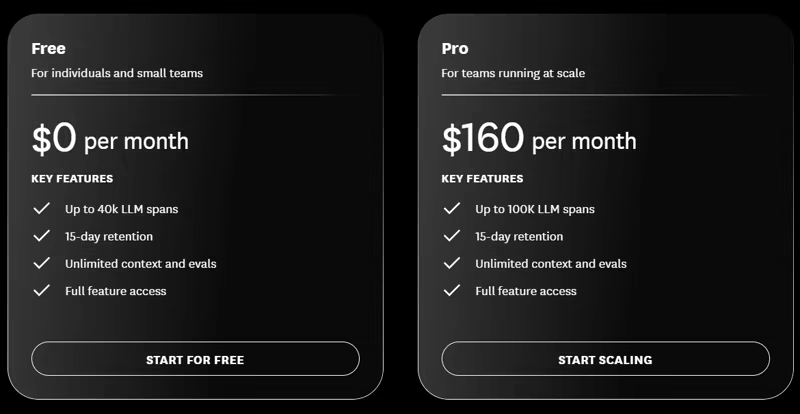
The free tier includes up to 40,000 LLM spans per month with 15-day trace retention. For the first 100,000 LLM spans per month, Pro starts at $160/month with an annual commitment, $200/month on a monthly commitment, or $240/month on demand.
Pros and Cons
Datadog is a practical Fiddler alternative for organizations already using its observability products. It connects agent quality with application and infrastructure monitoring. Insights helps narrow recurring failures, and billing counts LLM spans rather than every tool or workflow span.
Usage charges can increase with traffic, and longer retention costs extra. Offline experiments run against datasets but don’t restore recorded tool responses, so full agent replay needs separate controls.
7. Maxim AI
Maxim AI focuses on agent simulation, evaluation, and observability, including testing multi-turn conversations before release.
Features
- Record sessions, traces, spans, and tool activity using Maxim’s SDKs or OpenTelemetry ingestion. Set threshold-based alerts that notify your team through Slack or PagerDuty when monitored conditions are met.
- Apply online evaluators to selected production logs using filters and sampling rules, including individual generations, retrievals, and tools. Reviewers can assess the same logs manually, while selected examples and corrected responses can be added to evaluation datasets.
- Use Maxim’s simulation tools to generate conversations from scenarios and personas, with configurable tools and turn limits. For example, test how a support agent handles an angry customer seeking a refund before exposing real customers to that interaction.
- Use comparison reports and dashboards to examine evaluation scores and recurring failures across test runs. Assess whether changes to prompts, models, or agent settings improved behavior.
Pricing
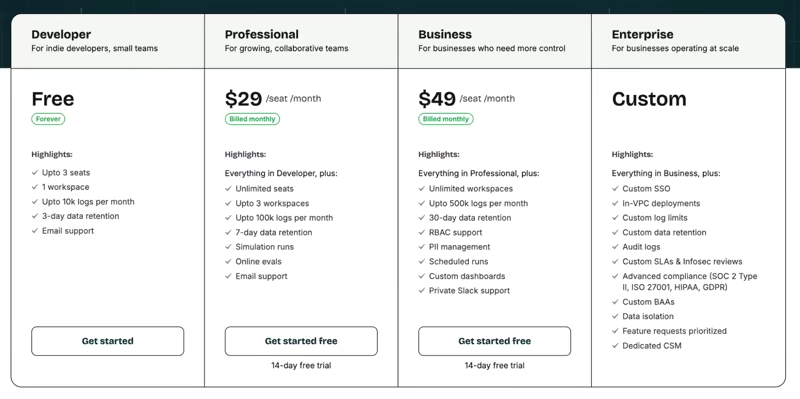
Maxim’s platform plans are per seat:
- Developer: Free for up to 3 seats
- Professional: $29 per seat per month
- Business: $49 per seat per month
- Enterprise: Custom
Pros and Cons
Maxim is strongest where Fiddler is thinnest: testing conversations before they happen. Simulation, node-level online evals, and log-to-dataset curation cover the loop from test to production and back. The entry plan includes three free seats.
Simulation runs and online evaluation of production logs start on Professional. Developer includes playground simulation and three days of log retention. Professional extends retention to seven days. Seats and log volume can increase costs. Synthetic conversations also aren’t a replay of recorded production tool results, and Maxim has no open-source edition or Kitaru importer.
8. Braintrust
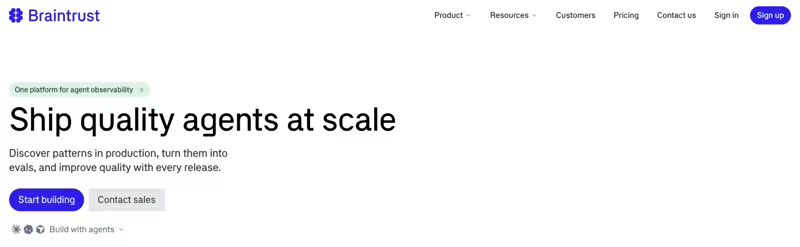
Braintrust is the eval-first platform, with datasets, scorers, and experiments as the core objects and production logging feeding them. Its homepage puts the pitch in one line: “Discover patterns in production, turn them into evals, and improve quality with every release.”
Features
- Record prompts, model responses, tool calls, nested spans, and evaluation scores through native SDKs or OpenTelemetry. Braintrust also supports pattern detection across production logs, helping teams identify recurring issues rather than investigating each failed interaction separately.
- Define custom scoring functions or LLM-as-a-judge evaluators to measure correctness, relevance, policy compliance, and other quality dimensions. Run these scorers on offline datasets or production traces, then compare scores across experiments to assess changes.
- Use Add to dataset in Logs or Review to convert a span into a test case. Braintrust copies its input and output, preserves the source link, and lets reviewers revise the expected answer before testing another version.
- Use remote evaluations to execute evaluation code on your machine or server while controlling the experiment from Braintrust. This supports testing actual application functions rather than limiting experiments to prompt templates. Experiment results can then be compared across code, model, or prompt changes.
Pricing
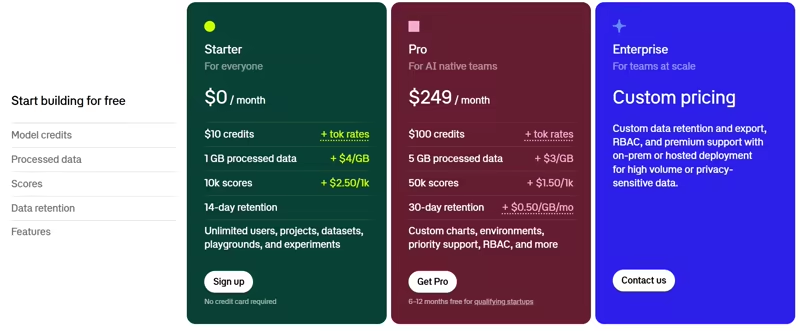
Braintrust has no platform fee on Starter and meters processed data and scores on every plan:
- Starter: Free
- Pro: $249 per month
- Enterprise: Custom pricing
Pros and Cons
Braintrust is useful for teams that want evaluation to guide their agent development process. Its production logging, dataset creation, custom scorers, and experiment tracking make it easier to turn reported failures into repeatable tests. Remote evaluations are also useful when teams want to test their own application code rather than an isolated model request.
The main limitations are cost and control over external dependencies. Braintrust charges for processed data and evaluation scores, so spending grows with trace volume and scoring frequency. Self-hosting requires Enterprise, and remote evaluations don’t supply recorded tool responses, so side-effecting agents need mocks or other controls. Kitaru can import Braintrust sessions when recorded-history replay is required.
Which Fiddler AI Alternative Is Best For You?
There is no one-for-one Fiddler replacement, because these tools split Fiddler’s job between them.
- Splunk Agent Observability and Datadog are the control planes, with production tracing, online evals, and enterprise controls in one platform, and each has its own acquirer or parent.
- Braintrust, LangSmith, and Maxim AI organize quality work around datasets, scorers, experiments, and simulation.
- Langfuse is the open-source pick if you want to own the trace store and keep a $29-a-month hosted option.
- Evidently AI fits when you want quality and drift checks as Python tests in CI, for traditional ML models as well as LLM apps.
And then there is the problem none of those categories fully resolves. Inspect a trace, score an output, and still not know whether the code or model change you are about to ship fixes the customer session that failed.
Kitaru runs your code with recorded tool calls answered from history. Point it at the sessions you already have, replay last month’s real traffic against the model swap or prompt rewrite you have been putting off, and see what breaks before your users do.
If you would rather not run that investigation yourself, ZenML Pro hosts Kitaru for your team and adds AI engineers that read every new trace next to your evals, show you what they miss, and ask you only when a session needs your call. Starter is $39 a month for one agent and your whole team, with a 14-day trial and no credit card.
- AI engineers on your agent
- Set up in minutes
- No credit card