
On this page
Maxim AI puts agent evaluation and observability into one platform. You get a prompt playground, agent simulation across scenarios, an evaluator store, annotations, and production tracing under one roof, on a per-seat bill.
Just when everything ticks your buying checklist, you notice that self-serve plans keep logs for 3 to 30 days, evaluation datasets have plan limits, and every engineer, product manager, or QA reviewer you add is another seat.
You start opening tabs, looking for Maxim AI alternatives because the tool felt like home a second ago, and now one of the three issues is giving you second thoughts.
We reviewed 8 Maxim AI alternatives for teams that need to evaluate agents, trace a bad run back to the step that caused it, and test a fix before it ships.
A Quick Overview of the Best Maxim AI Alternatives
- Why look for alternatives: Maxim’s self-serve plans retain logs for 3, 7, or 30 days. Dataset limits vary by plan, and paid tiers charge per seat. Ten Business seats start at $490 per month before overages.
- Who should care: AI engineers and platform teams running agents in production, plus the product and QA teams who judge whether an answer was actually right.
- What to expect: A review of 8 Maxim AI alternatives, from replay-based evals in Kitaru to eval-first Braintrust, open-source trace stores like Langfuse and Opik.
The Need for a Maxim AI Alternative?
Maxim is a capable platform, and nothing below says otherwise. The reason to look elsewhere usually comes down to retention, dataset limits, team access, or the kind of testing you want to run after a production failure.
Quick Heads-Up: Maxim’s top-level pricing URL now shows Bifrost, the company’s LLM gateway. The eval platform plans sit on a separate pricing page, and that’s where the numbers below come from.
1. Short Log Retention
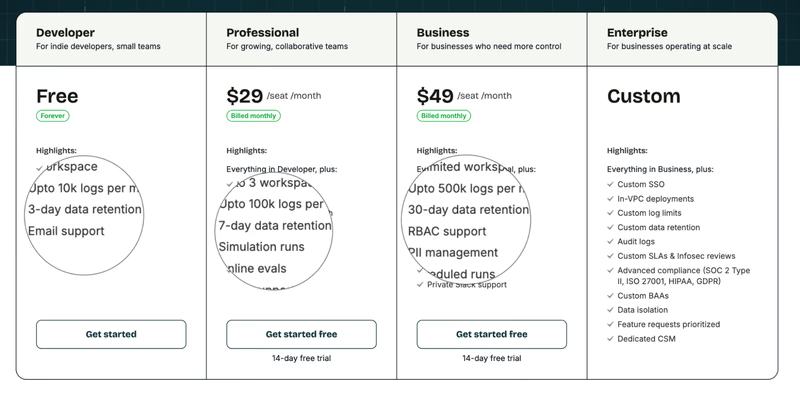
Maxim keeps logs for 3 days on Developer, 7 days on Professional, and 30 days on Business. Enterprise offers custom retention, but only if you are big enough to reach that level.
For startups and SMBs, the retention span is tight because what if you need to investigate an incident from six weeks ago or compare two releases across a quarter? Maxim can export logs and evaluation data as CSV. Its simulation product can also use earlier turns from a recorded conversation to test the agent’s next response.
2. Limits on Evaluation Datasets
Developer allows 3 datasets of 100 entries. Professional allows 10 datasets with 1,000 entries each, while Business allows 30 with 10,000 entries each.
Large regression suites, or one test set per customer workflow, can exceed these limits pretty quickly. A team running twelve agents, for example, cannot keep one separate dataset per agent on Professional without sharing or reorganizing them.
3. Costs Grow With Team Access
Professional costs $29 per seat per month, while Business costs $49 per seat per month. Ten Business seats cost $490 a month, before log overages at $1 per 10,000 logs.
That matters because agent quality is rarely an engineering-only job. Support, product, and QA often know which answers are acceptable, so giving more reviewers access can raise the bill even if usage stays flat.
Evaluation Criteria
We compared each Maxim AI alternative across three areas:
- Evaluations that reflect real application quality: The best tools let you define your own success criteria and combine code checks, LLM judges, and human feedback. Stronger options also score both individual steps and outcomes, then let you compare those scores with expert-reviewed failures.
- Root cause analysis: A useful trace should show the full path through model calls, retrievals, tool use, and agent handoffs. The goal is to narrow a bad result down to the step that caused the wrong answer, higher cost, or slow response.
- Reproducing failures and testing fixes: The strongest alternatives go beyond storing traces. They let you turn a failed production run into a repeatable test, and compare the new result with the original. Recorded tool responses matter here too. Reusing them keeps tests from depending on live external state and helps prevent side effects during replay.
What are the Top Alternatives to Maxim AI
| Maxim AI Alternative | Best For | Key Features | Pricing |
|---|---|---|---|
| Kitaru by ZenML | Replaying production sessions against one change | • Re-runs real agent code with recorded tool history • Immutable regression cohorts • Domain-expert review through investigations | • Free (open source) • ZenML Pro Starter $39/month |
| Braintrust | Eval-first teams that gate merges on scores | • Datasets, scorers, and experiments as core objects • Human review scores • Playgrounds promoted to experiments | • Free • Pro $249/month |
| Langfuse | A self-hosted, open-source trace store | • MIT core with OTLP ingest • Agent graph view • Trace to dataset in one click | • Free self-host or Hobby • Core $29/month |
| LangSmith | LangGraph and LangChain teams | • Trajectory evaluation • Annotation queues with rubrics • Online and offline evals | • Free • Plus $39/seat/month |
| Future AGI | Simulation on a usage-based bill | • Text and voice simulation • Replay a production conversation as a scenario • Gateway and guardrails included | • Free • Pay-as-you-go, add-ons from $250/month |
| Confident AI | DeepEval users who want a hosted layer | • 45-plus DeepEval metrics • Regression testing across test runs • Tracing billed per GB-month | • Free • Starter $200/month |
| Arize Phoenix | Self-hosted tracing with span replay | • OpenInference and OTel tracing • Span replay in the playground • Datasets and experiments | • Free (self-host) • AX Pro $50/month |
| Comet Opik | The cheapest hosted tier with an OSS core | • Apache 2.0 • Test Suites with execution policies • Annotation queues | • Free (open source) • Pro Cloud $19/month |
1. Kitaru by ZenML
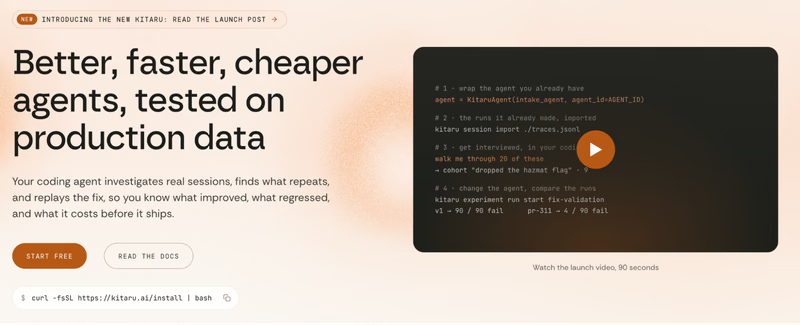
Kitaru by ZenML is an open-source, replay-based evaluation runtime for AI agents. It turns selected production runs into executable regression cases, so you can test a model, prompt, parameter, or code change against behavior your agent has already seen.
Kitaru can import sessions from Langfuse, LangSmith, Braintrust, Logfire, Arize Phoenix, or Kitaru JSONL, so nothing changes in production on day one. Your existing observability platform can stay the system of record while Kitaru handles the sessions you want to investigate, replay, and test.
Feature 1. Replay With Recorded Tool History

Replay a complete agent run from the start with the original inputs, then let the candidate agent reason and act again. Kitaru can apply model, prompt, and parameter overrides during replay, while code changes are tested through a new agent version.
A tool policy handles tool behavior so a test does not blindly repeat production runs. For example:
historyreturns the recorded result for the same tool name and argumentsstaticreturns a fixed answerpassthroughexecutes the live tool for safe readson_misscontrols what happens when no recorded call matches.
For calls the recording never saw, on_miss decides whether the replay fails, hands the agent an error result, or runs the tool live. To prevent a refund or database write from running again, configure a history policy with on_miss: fail for each supported tool that can cause those side effects. Matching calls return the recorded result, and unmatched calls stop the replay before the tool executes.
Feature 2. Turn Reviewed Failures Into Regression Cohorts

An evaluator is a small piece of your own Python or TypeScript that reads one session node by node and writes typed verdicts with an independent passed field. Ten deterministic checks ship built in, and a typed model judge ships as a separate package.
In Kitaru’s investigation, a support lead or domain expert can answer one question about a session. They can then mark sessions as acceptable, problematic, or uncertain, and pin annotations to a session, node, JSON path, or character span.
When you run the evaluator over the reviewed sessions, you will see where it disagrees with the humans. Problematic sessions become the cohort your next experiment replays. You can add successful counterexamples too, so a fix cannot pass by solving one bad case and breaking behavior that already worked.
Feature 3. Compare One Change Across the Same Production Cases

Run an experiment across a cohort with one candidate change, a tool policy, and pinned evaluator versions. Kitaru creates one replay per session and can score the baseline and candidate with the same criteria.
Use the comparison as a release check when the evaluator is good enough to gate changes. Use --wait to catch experiment run failures. To gate a release, have CI check the evaluator scores or verdicts against your release criteria.
Pricing
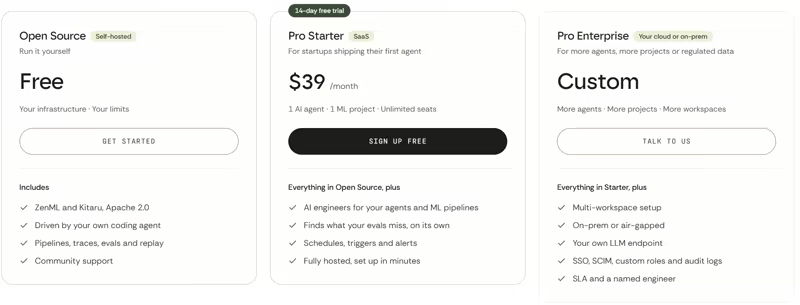
Kitaru is free to self-host under Apache 2.0, with unlimited recording, imports, cohorts, evaluators, experiment runs, and replay on your own workers.
The hosted option is ZenML Pro, which hosts Kitaru for your team and adds AI engineers that read every new trace next to your evals. Pro Starter offers a 14-day free trial with no credit card. Pro Enterprise has custom pricing:
- Pro Starter: $39 per month; 1 AI agent, 1 ML project, unlimited seats, hosted dashboard, schedules, triggers and alerts.
- Pro Enterprise: Custom; more agents and projects, on-prem or air-gapped deployment, your own LLM endpoint, SSO, SCIM, custom roles and audit logs, and an SLA.
Pros and Cons
Kitaru is the only tool here that re-runs the agent’s code against recorded behavior, works beside your current trace store, and executes replay jobs on workers you control. Replay runs on your own workers with your own keys. ZenML Pro Starter carries no per-seat bill.
However, Kitaru is a young project and therefore less mature than Maxim AI. Interfaces can change. It is also not a live observability dashboard or production agent runtime. Imported traces still need runnable agent code before you can replay them.
2. Braintrust
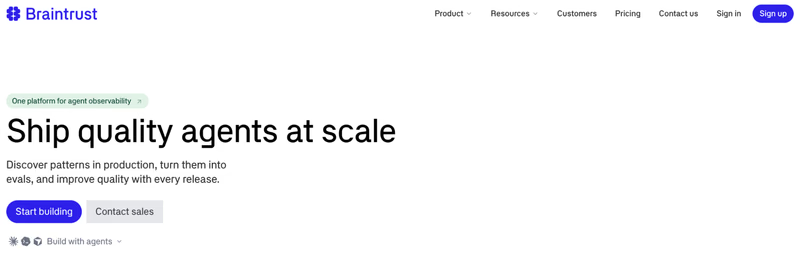
Braintrust is built around evaluation first. Its core objects are datasets, tasks, scorers, experiments, and production logs, which makes it a good fit if your team treats evals as part of development instead of a final QA step.
Features
- Trace complete runs with nested spans typed as task, llm, tool, and function. Each span carries inputs, outputs, metadata, latency, tokens, and cost, so the failing step helps you trace a poor result back to the step that produced it.
- Score behavior with code, model judges, or human review through categorical, continuous, or free-form fields. Experts fill those in row by row, and you promote reviewed logs into datasets.
- Compare prompts and models in Playgrounds by linking a dataset and running variants side by side. Promote the chosen configuration into an experiment when you want the comparison stored with repeatable inputs and scores.
Pricing
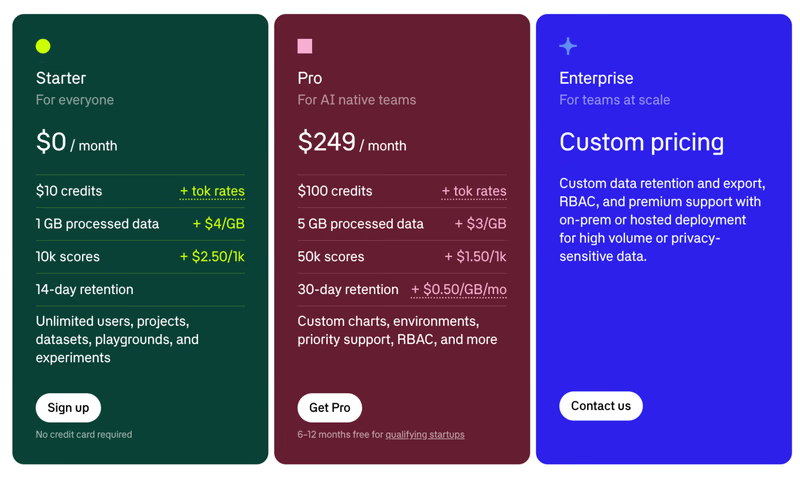
Braintrust offers a free Starter plan with 1 GB of processed data, 10,000 scores, 14-day retention, and unlimited users. Beyond that, it has two paid tiers:
- Pro: $249 per month
- Enterprise: Custom pricing
Pros and Cons
Braintrust replaces Maxim’s per-seat model with unlimited users on every plan. Its review tools add assignable review work to the scores and datasets above.
Processed data and scores are metered separately, and self-hosting is Enterprise only. The Playground can run full-agent evaluations through a remote eval or a Braintrust-managed sandbox. Your eval code controls whether tools are live or mocked.
Read our Braintrust pricing breakdown and Kitaru vs Braintrust.
3. Langfuse
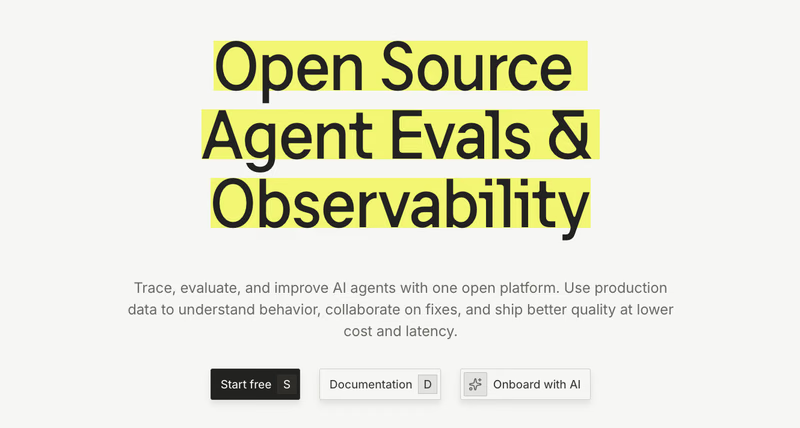
Langfuse is an open-source tracing and evaluation platform. It replaces Maxim’s observability half well and its evaluation half partially. It is a strong alternative if you want to own the trace store and keep evaluation close to production telemetry.
Features
- Trace model calls, retrievals, tool use, and custom logic as observations with cost and latency attached per step. The agent graph view helps you follow loops and handoffs across a run when a flat list starts feeling like archaeology.
- Add any observation on a production trace to a dataset from the UI or through bulk workflows with JSON-path field mapping. This gives you a direct path from “we saw this fail” to “we test this case again.”
- Score and compare behavior with judges, SDK scores, and annotation queues. UI experiments can compare prompt versions and models, while full application and agent experiments run through the SDK.
Pricing
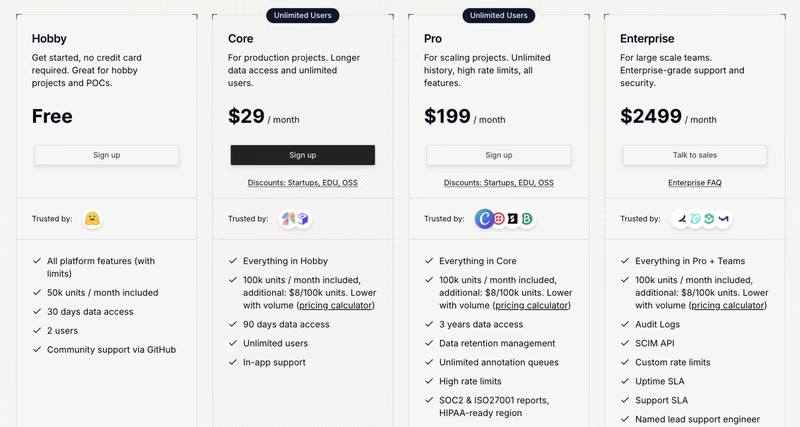
Langfuse offers a free open-source and a hosted Hobby plan. Langfuse Cloud meters billable units across traces, observations, and scores:
- Core: $29 per month; 100,000 units, unlimited users, 90 days.
- Pro: $199 per month; three years of retention.
- Enterprise: $2,499 per month.
Pros and Cons
Langfuse’s Unlimited users at $29 a month is an appealing answer to Maxim’s per-seat pricing. Core includes unlimited users for $29 per month, and the self-hosted edition gives you control over retention and infrastructure.
The tradeoff is replay depth. Langfuse can help you collect the case, score it, and run application experiments, but the trace itself does not answer future tool calls. Experiments on agent code hit live tools unless you mock them, so Langfuse gives you the dataset, not the controlled re-run. Kitaru imports from Langfuse for that.
Read our Langfuse pricing guide and Kitaru vs Langfuse.
4. LangSmith
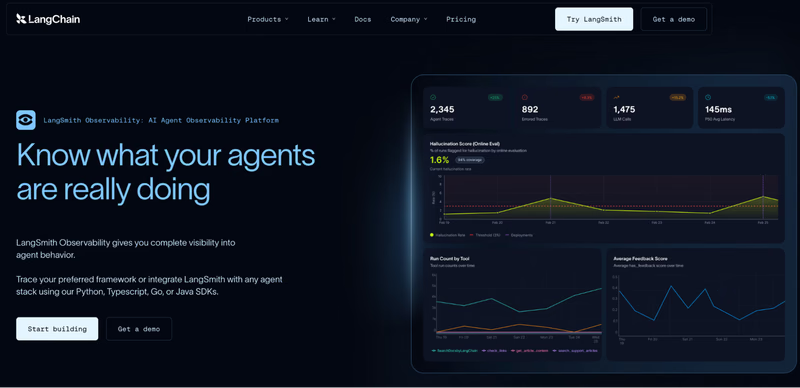
LangSmith is LangChain’s observability and evaluation platform. It works outside LangChain too, but its deepest workflow support shows up when your stack already uses LangChain or LangGraph.
Features
- Group nested runs into traces and threads so you can inspect a multi-turn agent across model calls, tools, and child runs. Feedback can attach to individual runs, so you can judge not only the final answer but each step.
- Evaluate agent trajectories with single-step or multi-step evaluators that inspect the sequence of messages and tool calls. The open-source
agentevalspackage adds trajectory checks for teams that care about how the agent reached an answer, not only the answer itself. - Route production runs into annotation queues with reviewer rubrics and feedback configs. You can also correct inputs or outputs and turn those edits into reference examples for future datasets.
Pricing
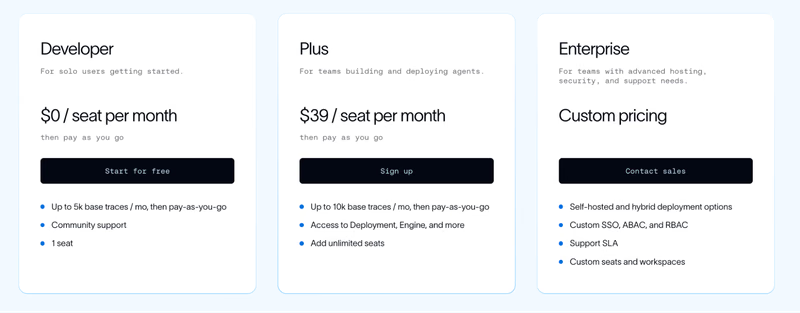
LangSmith has a free Developer plan with 1 seat and 5,000 base traces per month.
- Plus: $39 per seat per month
- Enterprise: Custom pricing
Pros and Cons
LangSmith stands out when trajectory quality matters and the agent already lives in the LangChain ecosystem. Its annotation and evaluation tooling can score both complete runs and the decisions inside them.
However, per-seat pricing plus a per-trace meter matches Maxim’s bill, and retention is a paid upgrade. Full-agent evaluations also execute your application code, so live tools still need their own test controls if you want repeatable external behavior.
Our LangSmith pricing guide has the meter details; Kitaru vs LangSmith covers the replay gap.
5. Future AGI
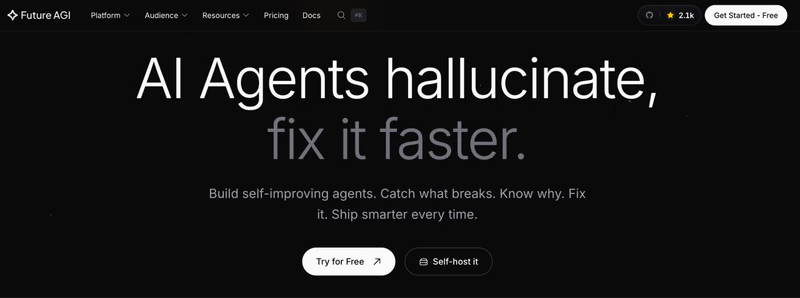
Future AGI combines tracing, evaluation, simulation, an AI gateway, and guardrails on a usage-based bill with no per-seat pricing. Its traceAI instrumentation is open source and OpenTelemetry-based, and the platform lists a self-hosted edition on GitHub.
Features
- Trace agent activity across frameworks with typed spans, sessions, agent graphs, and evaluation scores. This helps teams connect a low score to the model, tool, or sub-step that caused it.
- Simulate text and voice conversations across personas and scenarios before those cases reach users. Production conversation replay can turn a real interaction into a scenario you run against a newer agent version.
- Manage datasets, prompts, annotations, and agent tests from the same platform when you want simulation and evaluation in one workflow. This fits teams testing support agents, voice agents, or other conversation-heavy products.
Pricing
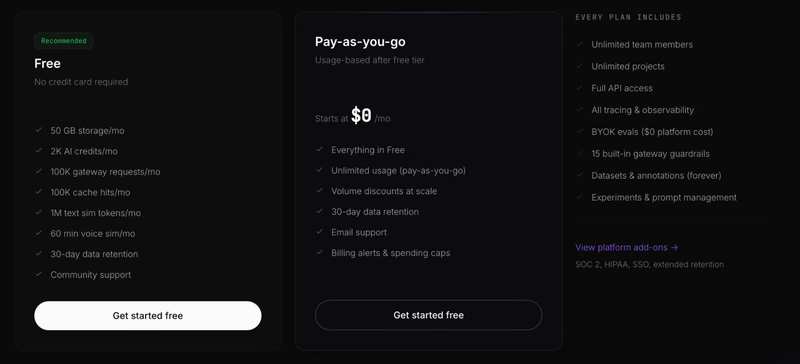
Future AGI has a generous free forever plan that includes free allowances for trace storage, AI credits, simulation tokens, gateway requests, and tracing events. Beyond the free limits, it has usage-based pricing, with spending caps.
Pros and Cons
Future AGI answers two of the three Maxim complaints. It has no seats, and retention is an add-on rather than a tier. That makes it a useful Maxim alternative when synthetic scenarios are central to how you test agents.
Chat replay uses the recorded conversation as a script and runs it against the agent version you choose. If the agent touches real systems during a rerun, you still need safeguards around those calls. It is also a broad, young platform. The compliance controls sit behind the add-ons.
6. Confident AI
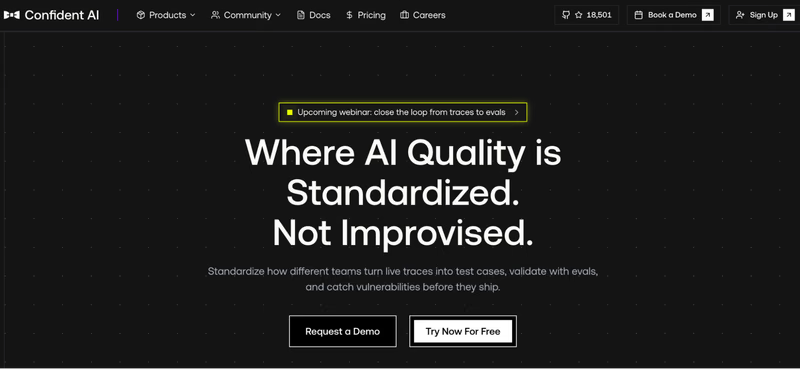
Confident AI is the hosted platform from the team behind DeepEval, the open-source evaluation framework. It’s a natural fit if your evaluation code already uses DeepEval test cases and metrics.
Features
- Score outputs with 30-plus single-turn and 15-plus multi-turn metrics, including G-Eval criteria and deterministic checks. This works well when your team wants evaluation logic in code but also needs a hosted place to inspect runs and results.
- Compare test runs for regressions across prompts, models, or application changes. Production traces can feed evaluation datasets, so failures from live traffic can become future test cases.
- Review traces and test cases through annotation queues. Starter adds online evals on live traffic, chat simulations, and no-code evaluation of live endpoints. This way, your QA and domain experts have a UI for judging cases without asking them to read raw trace JSON.
Pricing
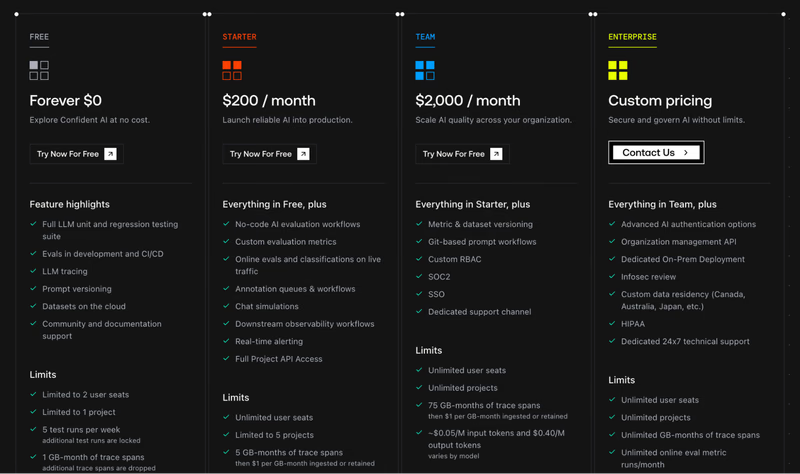
Confident AI bills tracing per GB-month and lets you set retention yourself. Its free plan offers 2 seats, 1 project, 5 test runs per week, and a GB-month of spans. You can always upgrade to paid tiers like:
- Starter: $200 per month
- Team: $2,000 per month
- Enterprise: Custom pricing
Pros and Cons
Retention is a slider rather than a plan tier, and seats are unlimited from Starter up. That removes both Maxim complaints at once.
However, the jump from $200 to $2,000 is steep if SSO is all you need, and the Free tier’s five test runs a week is tight. Re-running an agent still hits live tools.
7. Arize Phoenix
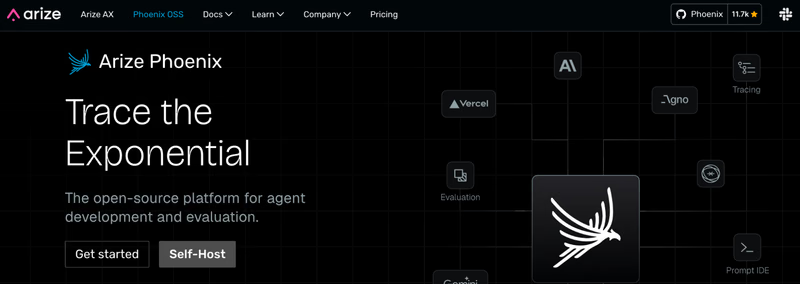
Arize Phoenix is Arize’s self-hosted tracing and evaluation tool. It uses OpenTelemetry and OpenInference, while Arize AX is the managed platform that adds hosted monitoring and team features.
Features
- Trace agent runs step by step with OpenInference instrumentation and OTLP ingest. Auto-instrumentation covers common frameworks, while custom spans fill in the parts your framework does not expose by default.
- Evaluate traces and spans with LLM-based evaluators, code checks, or human labels. Datasets and experiments let you test a change on the same inputs and compare scores.
- Replay an individual LLM span in the prompt playground with a different prompt, model, or input. This is useful when one model call is the problem, and you want a fast local comparison without re-running the entire agent.
Pricing
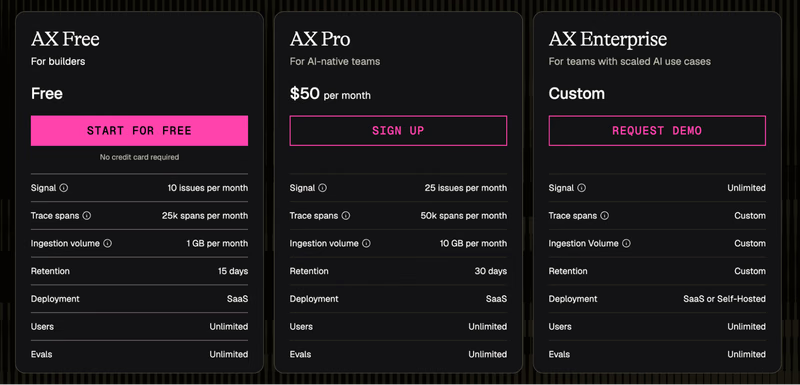
Phoenix is free to self-host on Docker or Kubernetes. Arize AX offers managed plans, including:
- AX Pro: $50 per month
- AX Enterprise: Custom pricing
Pros and Cons
Phoenix gives you a trace store on your own infrastructure with no seat count. Span replay lets you debug a single bad model call in the playground.
However, the license is source-available rather than OSI-approved. Phoenix includes project-level metrics dashboards and can replay individual LLM spans. Arize AX adds automated online evaluations on production traces. To sort that, Kitaru ships a Phoenix importer for the sessions you want to re-execute.
Must read:
8. Comet Opik
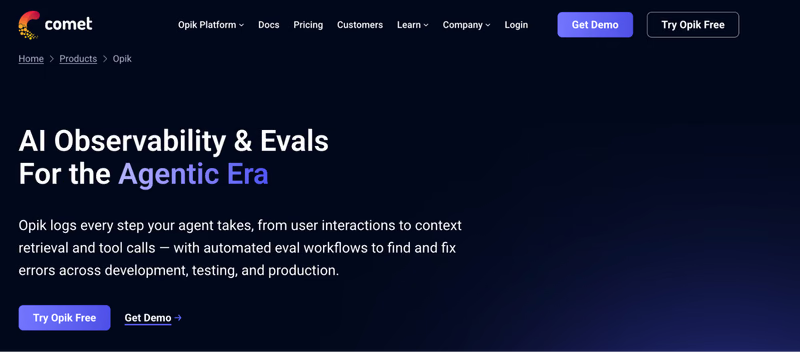
Opik is Comet’s open-source observability and evaluation project, Apache 2.0 licensed. The same codebase runs self-hosted or in the cloud.
Features
- Trace complete agent behavior through trace trees, threads, and agent views. Framework integrations and SDK instrumentation give you the step-level evidence you need when a final answer alone cannot explain the failure.
- Turn failed behavior into repeatable Test Suite items with natural-language assertions and execution policies. Policies can run the same item more than once and require a minimum number of passes, which helps with nondeterministic model behavior.
- Score and review production behavior with built-in metrics, LLM juries, annotation queues, and online evaluation rules. Domain experts can review the same trace data engineers use for debugging.
Pricing
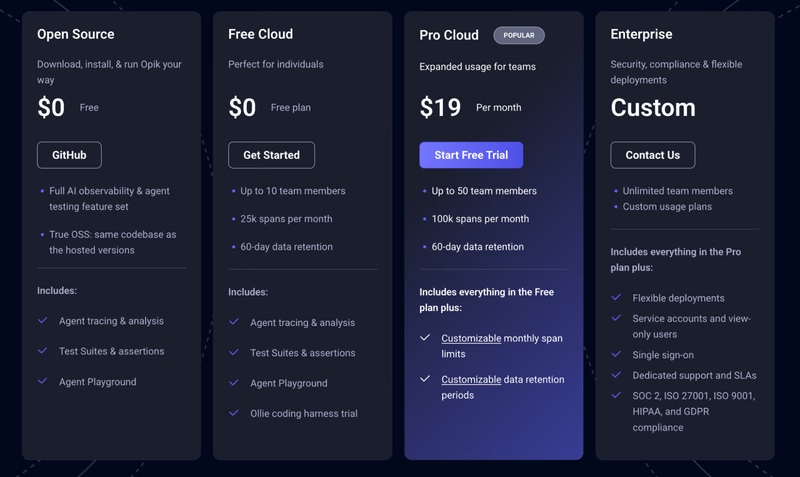
Open Source: Free; unlimited spans, retention, and seats when self-hosted.
- Free Cloud: $0; 25,000 spans per month, 60-day retention, 10 members.
- Pro Cloud: $19 per month; 100,000 spans, 50 members, then $5 per 100,000 spans.
- Enterprise: Custom; RBAC, SSO, and self-hosted deployment.
Pros and Cons
Opik has the lowest fixed-price hosted tier here, and the free self-hosted path has no ceiling, so Opik removes Maxim’s seat and retention pressure. Test Suites bridge a broken trace and a regression check.
However, the suite runs your task function with live tools, so external variability is yours to control. RBAC and SSO are Enterprise only.
Wrapping Up
Maxim’s problems are commercial more than technical: short retention, dataset caps, and a seat count that grows with everyone who has an opinion about an answer. Each alternative fixes a different part.
- Langfuse, Opik, and Phoenix put the trace store on your own infrastructure, with no seats to count.
- Braintrust and Confident AI center the workflow on evals and human review, with unlimited users from their first paid tier.
- LangSmith scores agent trajectories and goes deepest for LangGraph teams.
- Future AGI covers simulation and voice on a usage-based bill.
Underneath all of those sits the third criterion. Every one of these tools can show you the run that failed. Kitaru reruns your agent’s code and can reuse recorded responses for supported tool calls that match the recording.
That is what you need before a model swap or a prompt rewrite ships, and it is the job Kitaru was built for. Point it at the traces you already have in Langfuse, LangSmith, Logfire, or Phoenix, replay last month’s real sessions against the change, and see what breaks before your users do.
If that’s the problem on your desk, book a demo with our founding engineer, or try it yourself: it is open source at github.com/zenml-io/kitaru.