
On this page
Braintrust is an evaluation and observability platform for LLM apps. You define an eval as data, a task, and scorers, run experiments against it, and score what your application produced.
But when the agent run extends, or becomes long, noisy, and costly, Braintrust gets uncomfortable. And there are reasons, like:
- Long multi-turn traces cost more
- Every scorer you attach burns the per-score meter
- Key governance controls sit on the enterprise plan
Then came the May 2026 security incident, after which Braintrust asked customers to rotate provider keys following unauthorized access to an AWS account. Braintrust contained the incident, but it raised a basic question: where should traces and provider credentials live?
For this article, we reviewed eight Braintrust alternatives for AI engineers who run production agents and need evaluation infrastructure they can afford, audit, and self-host.
A Quick Overview of the Best Braintrust Alternatives
- Why Look for Alternatives: Braintrust’s per-GB and per-score billing can climb quickly on long agent runs. Self-hosting, custom retention, and governance sit on Enterprise, plus the recent security incident has pushed many users on the back foot.
- Who Should Care: AI engineers, platform teams, and agent developers who own production systems and want more control over traces, provider keys, and test data.
- What to Expect: Eight Braintrust alternatives, from replay-and-evaluation test benches like Kitaru to observability platforms like Langfuse, Arize Phoenix, Opik, and MLflow 3.
The Need for a Braintrust Alternative?
Some reasons you may want to look beyond Braintrust:
Reason 1. Pricing Structure That Scales Badly for Agent Workloads
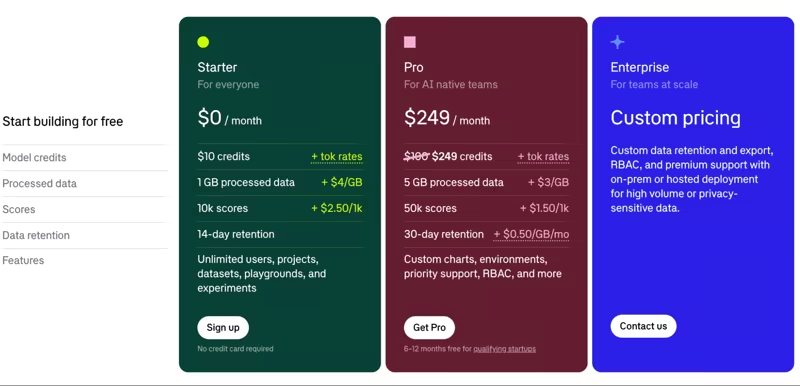
Braintrust’s pricing jumps from a free Starter tier to a $249 per month Pro plan. Pro includes a fixed allowance for processed data and evaluation scores before overages begin. Overages bill at $3 per GB and $1.50 per 1,000 scores. On the free Starter tier, the same overages are worse: $4 per GB and $2.50 per 1,000 scores.
There isn’t much of a middle ground in Braintrust’s pricing. Enterprise removes some limits, but pricing is not public. You are negotiating with sales before you even know what the platform costs at your volume.
Reason 2. Closed Source, With Governance Gated to Enterprise
Braintrust does not offer an open-source edition. Starter and Pro use its managed service, while Enterprise adds self-hosted and bring-your-own-cloud options.
That stands out because Langfuse, Arize Phoenix, Opik, MLflow, and DeepEval all publish their core code under open licenses. For teams with strict residency or internal data rules, Braintrust’s lower tiers may not fit.
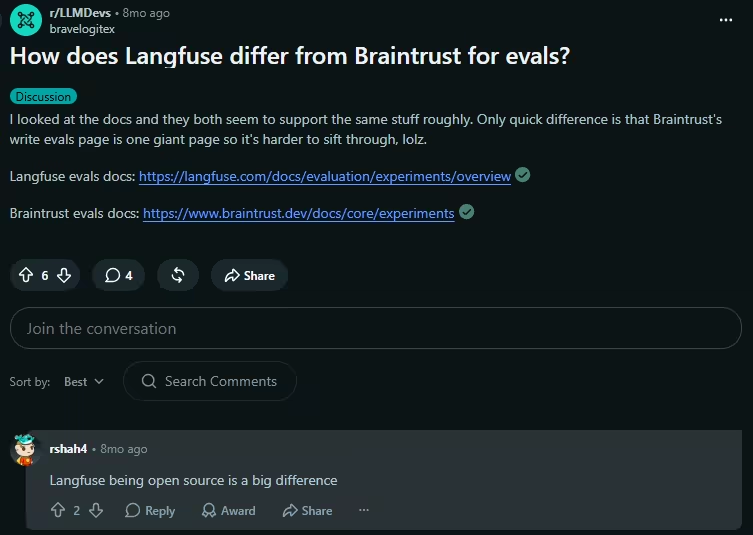
Recent buyer discussions point to the same concern. In one Reddit thread, a developer called Langfuse’s open-source model a major difference compared with Braintrust.
Reason 3. Eval-First Architecture, Weak Execution Control
Braintrust remains primarily an evaluation and observability layer. It can trace production agents and run its own evals, but it does not own the durable execution of your production agent. It cannot suspend an active execution, hold a tool call for approval, or resume from a durable runtime checkpoint.
That is not a tracing weakness, rather an intended boundary between an evaluation platform and an execution runtime.
Users also report that custom evaluations and datasets can take time to learn. Search across older experiments could be more flexible, while deeper CI/CD work may require more scripting than expected.
Evaluation Criteria
We evaluated each alternative against four criteria that matter most for agent observability.
Cost model
We looked at starting price, pricing structure, and what happens as traces or scores grow. We also checked whether scoring is billed separately and whether a practical middle tier exists.
Open source and deployment
We looked for tools that allow you to inspect the core code and run the platform in your own cloud without an Enterprise contract. Generally, tools offering open-source options are preferred over closed-source ones.
Data ownership, portability, and lock-in
We checked support for OpenTelemetry or another open format, plus export options for traces and datasets. For those switching from Braintrust, we also considered how hard it would be to move historical data later.
Agent debugging
We compared how each platform handles multi-turn sessions, tool paths, and production failures. We also looked for features that turn failed runs into tests or replay the original execution.
What are the Top Alternatives to Braintrust?
Before we dive into the tool reviews, here is a quick comparison:
| Braintrust Alternative | Best For | Key Features | Pricing |
|---|---|---|---|
| Kitaru by ZenML | Production-session replay and agent regression testing | - Full-session replay against recorded tool history - Baseline vs. candidate evaluations - Versioned production cohorts | - Free open-source - Paid plans start at $39/month |
| Langfuse | Open-source LLM observability | - Agent tracing and evals - Reusable production test datasets - SOC 2 Type II and ISO 27001, four data regions | - Free Hobby tier - Paid plans start at $29/month |
| LangSmith | Managed agent observability | - Tracing and online/offline evals - Engine analyzes failures and proposes fixes - Managed deployment | - Free Developer tier - Paid plans start at $39/seat/month |
| Arize Phoenix | OTel-native tracing without lock-in | - OpenTelemetry tracing - LLM-as-judge evals - Runs locally, in Docker, or on Kubernetes | - Free self-hosted - Arize AX Pro at $50/month |
| Opik by Comet | Lowest-cost cloud with an Apache 2.0 core | - Agent tracing and analysis - 30+ evaluation metrics - Automatic prompt optimization | - Free tier - Paid plans start at $19/month |
| MLflow 3 | Unified ML and GenAI platform | - OpenTelemetry-based tracing - GenAI evaluation and prompt registry - AI Gateway for provider access | Free and open source |
| W&B Weave | Agent-native tracing with built-in scorers | - Sessions and turns are first-class trace concepts - Pre-built safety and quality scorers - Alerts to Slack and webhooks | - Free - Paid plans start at $60/month |
| Confident AI | Regression testing on DeepEval | - LLM regression testing suite - DeepEval metrics - Custom data residency options | - Free tier - Paid plans start at $200/month |
1. Kitaru by ZenML
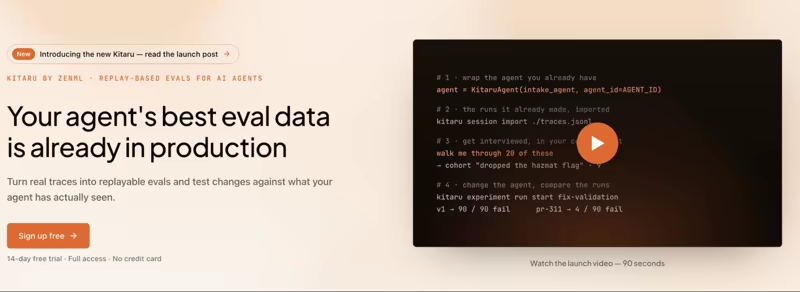
Kitaru is an open-source, self-hosted test bench for replaying and evaluating AI agents. It sits beside your production stack, so you can keep the framework and tracing setup you already use.
Braintrust experiments start with a dataset, a task, and scorers. Kitaru can start one step closer to production. It records or imports complete agent sessions, then re-executes your agent code against the tool history captured during the original run.
That gives you a different way to answer regression questions. Instead of testing a recreated example that resembles a production failure, you can test the session where the behavior actually happened.
Some key features Kitaru offers:
Feature 1. Re-Run Production Sessions Without Calling Live Tools Again
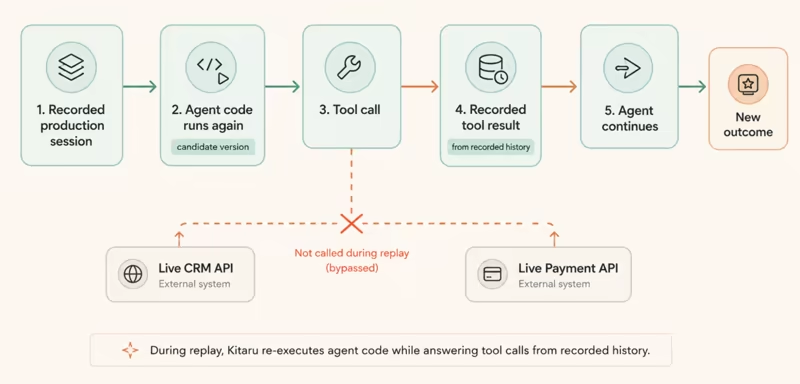
Kitaru re-executes an agent from the beginning while matching tool calls against recorded tool history. The new agent version sees the same external responses as the original run without calling your CRM, payment service, database, or another production system again.
Suppose a support agent offers the wrong account credit after checking billing history and subscription status. You can replay that session with revised agent code and inspect whether it now reaches the right decision without raising another live billing request.
This is a full-run replay in the current beta release. Kitaru does not jump into an arbitrary midpoint, and a tool call that cannot be matched to recorded history can cause the replay to fail or return an inconclusive result.
Feature 2. Judge the Baseline and Candidate With the Same Evaluator
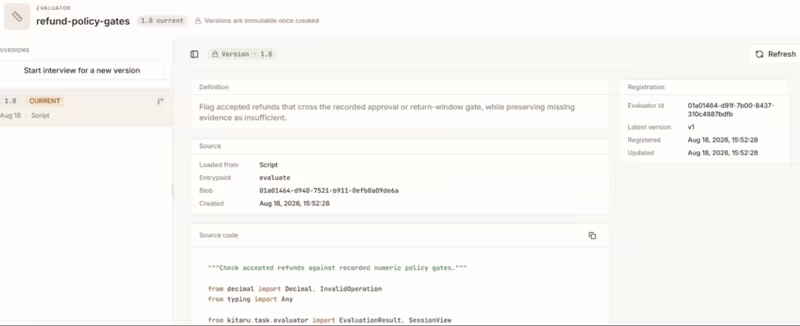
Kitaru pairs replay with versioned evaluators. You can score the original session and the candidate replay against the same evaluator version, which keeps your test criteria fixed while the agent changes.
For example, an evaluator could check whether a support agent verified subscription eligibility before offering a credit. Another could judge the final response. If you later change that rubric, Kitaru keeps the evaluator version attached to the evaluation so you know which rule produced each score.
That makes comparisons easier to interpret. A higher score should come from a different agent result, rather than an evaluation rule that quietly changed between experiments.
Feature 3. Test Changes Against Fixed Cohorts Built From Production Sessions
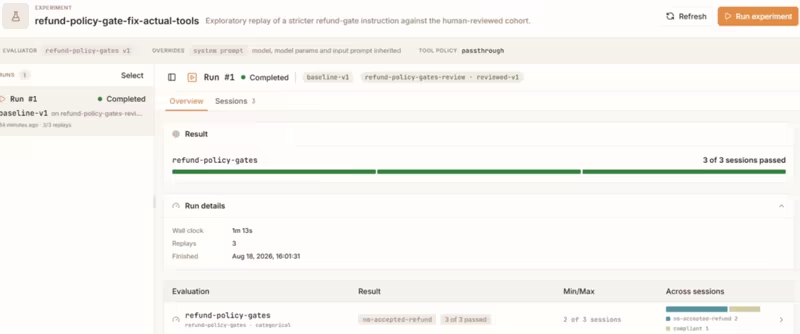
Braintrust gives you datasets for repeatable experiments. Kitaru uses production-derived cohorts for a similar job, but the unit being tested is the recorded agent session rather than only an input-output example.
You might build a cohort from sessions where users changed their request midway through a conversation, or where the agent called three or more tools. Once that cohort is versioned, its membership stays fixed for the experiment.
You can then run a candidate agent version across the same cohort and compare it with the baseline. New sessions can enter a later cohort version without quietly changing the test set you are already using.
Feature 4. Keep Replay Infrastructure Beside the Stack You Already Run
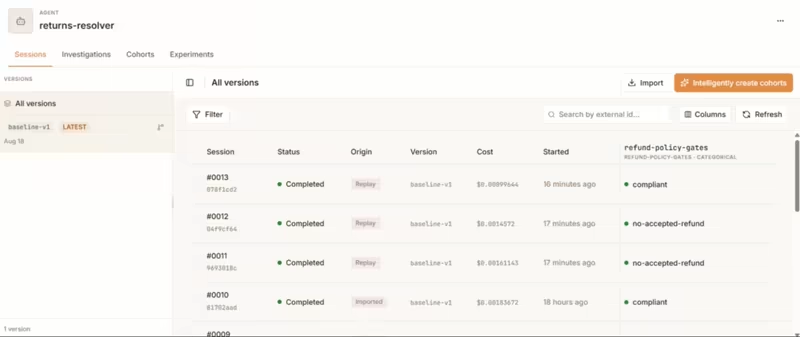
Kitaru does not require you to move production execution into a new agent runtime. It can record sessions directly or work with supported imported session data, then use adapters to re-run your actual agent code during replay.
The platform itself is self-hosted with FastAPI and PostgreSQL. Replay jobs run through workers controlled by your team, which keeps execution and test data inside the infrastructure you manage.
If Braintrust’s managed setup is the part you want to move away from, Kitaru can handle replay and evaluation while your existing framework continues running the agent and your observability stack continues watching production.
Pricing
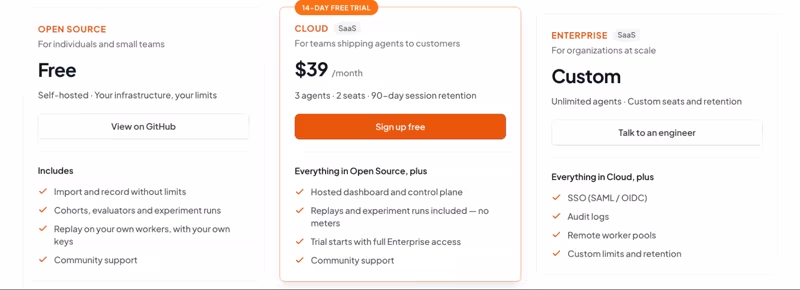
Kitaru is open source and free to self-host. You run the FastAPI service, PostgreSQL backend, and replay workers in infrastructure your team controls, so direct infrastructure costs depend on where and how you deploy it.
Other than the open source version, we offer two hosted plans:
- Cloud: $39 per month
- Enterprise: Custom
Pros and Cons
Kitaru is the strongest fit here when your evaluation work needs more than scoring stored outputs. Full-session replay lets you run changed agent code against production-derived cases, while versioned evaluators and fixed cohorts give you a repeatable comparison between the baseline and candidate.
There are boundaries to know before adopting it. Kitaru is still in beta, and replay currently starts from the beginning of the session rather than a mid-run checkpoint. Replay quality also depends on the recorded tool history. Kitaru is not meant to replace your primary observability platform or the runtime serving your production agents.
2. Langfuse
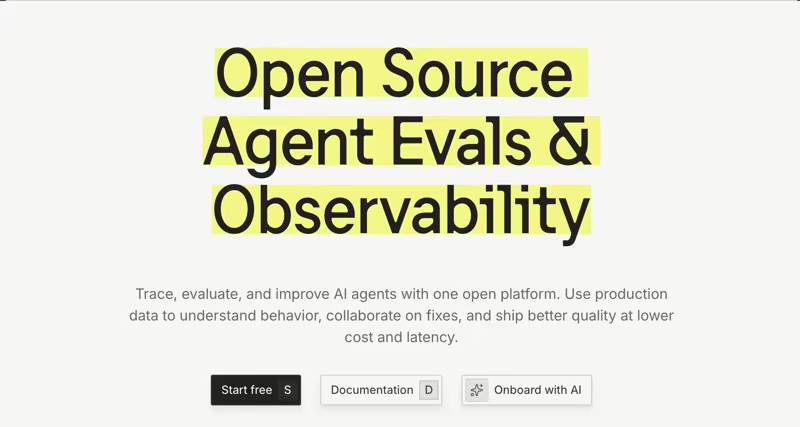
Langfuse is an open-source LLM observability platform and the closest like-for-like Braintrust alternative here. It covers tracing, evaluations, prompt management, experiments, annotation, and a playground in one stack.
Features
- Trace complete agent runs through Python, JavaScript, OpenTelemetry, or supported framework integrations. Langfuse groups model calls, tool calls, retrieval steps, and other spans into one trace or session, so you can follow the full execution path and compare latency, token use, cost, and errors.
- Turn production traces into evaluation datasets by saving useful or failed runs as test cases. You can rerun experiments against those datasets, attach LLM-as-a-judge scores, add custom evaluators, and collect human feedback inside the same project.
- Self-host Langfuse with Docker Compose or Kubernetes. A production deployment uses Postgres, ClickHouse, Redis, and S3-compatible object storage, which gives you control over storage, access, backups, and retention.
- Choose the region where managed data is stored through a Langfuse Cloud region in the US, EU, or Japan. Pro also includes a HIPAA-ready US region plus access to SOC 2 Type II and ISO 27001 reports.
Pricing
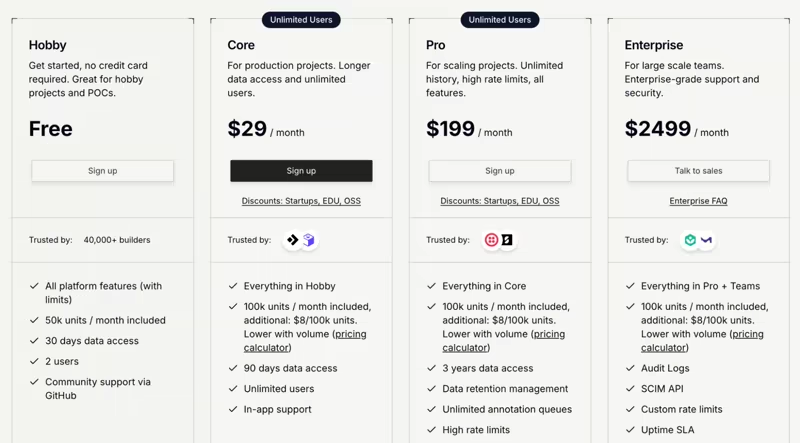
Langfuse Cloud has a free Hobby tier and three paid plans:
- Core: $29 per month
- Pro: $199 per month
- Enterprise: $2,499 per month
Read our detailed guide on the best Langfuse alternatives.
Pros and Cons
Langfuse addresses three common Braintrust complaints. It has a free self-hosted path, a $29 middle tier, and regional cloud options without an Enterprise deal. Its trace, eval, and prompt features also make it familiar to Braintrust users.
However, running it yourself means operating ClickHouse, Postgres, Redis, and object storage. That is real infrastructure work. Cloud pricing still uses a usage unit, so busy multi-agent systems should estimate event volume before choosing a plan.
3. LangSmith
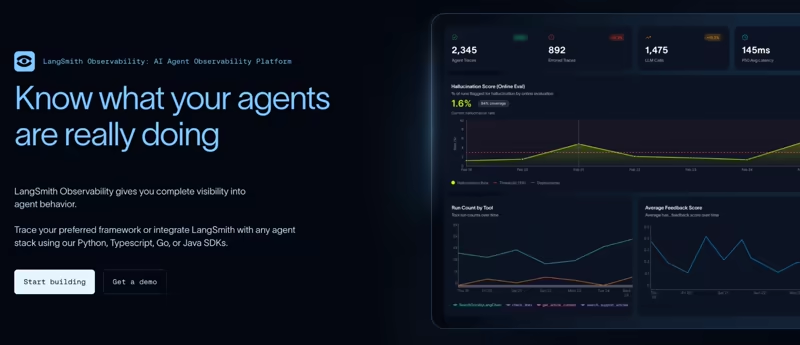
LangSmith is LangChain’s managed platform for tracing, evaluation, deployment, and agent operations. It has grown from an observability tool into a broader suite with deployment, sandboxes, an LLM gateway, and Engine.
Features
- Trace every step of an agent run across model calls, tools, retrieval steps, errors, latency, and user feedback. LangSmith connects each event to the wider run, which helps you see where behavior changed and which component caused the failure.
- Build test datasets from real production traces and run online or offline evaluators against them. You can also route uncertain or high-value runs to annotation queues, so human reviewers can score outputs and add feedback for later tests.
- Let Engine inspect recurring failures on a schedule. It groups similar agent behavior, suggests likely causes, recommends prompt or code changes, and can create evaluators or dataset examples for future tests.
- Deploy long-running agents with persistent threads, streaming, schedules, background runs, and state APIs. This keeps tracing and hosting inside one platform.
Pricing
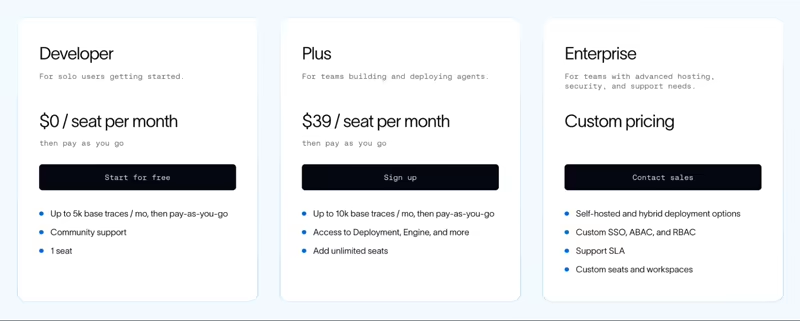
LangSmith uses seat-based plus usage pricing. The Developer plan is free for one seat with 5,000 base traces per month, extendable with two paid plans:
- Plus: $39/seat per month
- Enterprise: Custom pricing
Read our detailed guide on the best LangSmith alternatives.
Pros and Cons
LangSmith is the broadest managed suite in this category. The engine goes beyond showing a bad span and proposes fixes, like the next test or code change. The 14-day versus 400-day trace split also lets you keep only selected runs for longer.
Many Braintrust objections still apply. LangSmith is closed source, and self-hosted or hybrid deployment requires Enterprise. Bills can mix seats, traces, storage units, and compute units. Engine is also in beta, so its suggestions still need review.
4. Arize Phoenix
Arize Phoenix is a tracing and evaluation platform built around OpenTelemetry and OpenInference. It is a strong choice when trace portability matters as much as the dashboard.
Features
- Instrument agent applications through OpenTelemetry and OpenInference instead of a closed trace format. The same telemetry can work across supported frameworks and providers, while leaving you free to send it to another backend later.
- Use Phoenix’s trace view to inspect complete agent sessions across model calls, retrieval steps, tools, token use, latency, and errors. Phoenix connects each span to the surrounding trace, so you can see both the individual event and the conversation around it.
- Evaluate outputs and traces with LLM-as-a-judge metrics and custom scoring logic. Because experiments and traces share one data model, failures can move from monitoring into repeatable tests without a separate export process.
- Run Phoenix locally or on your own cluster through a local process, Docker, or Kubernetes. Arize AX provides a managed option later, so you can begin with self-hosting and move to a hosted service if operations become a burden.
Pricing
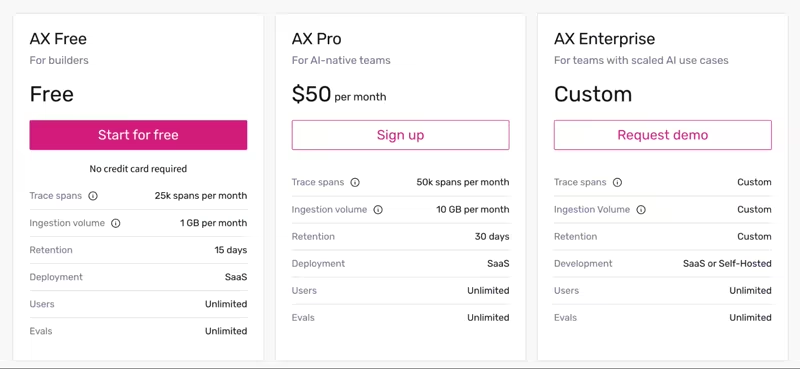
Phoenix is free to self-host. The managed AX platform has a free tier, and two paid tiers:
- AX Pro: $50 per month
- AX Enterprise: Custom pricing
Read our comparison of Langfuse vs Arize Phoenix.
Pros and Cons
Phoenix is a strong pick when OTel-native portability is the core requirement and you want tracing plus evals without license spend. It also gives teams a clear path from local use to a managed service.
The main caveat is licensing. ELv2 is source-available but not OSI-approved open source. It permits internal use and modification but restricts offering Phoenix as a hosted service to third parties. Enterprise controls such as SSO and custom retention live in Arize AX.
5. Opik by Comet
Opik is Comet’s open-source platform for AI observability and evals. It pairs an Apache 2.0 core with the lowest paid cloud tier in this comparison, while the self-hosted edition uses the same main codebase as the hosted service.
Features
- Capture every important event in an agent run from the user request through model calls, tools, errors, token use, and cost. Opik groups these events into sessions and execution graphs, which helps you understand how the agent reached its final response.
- Build reusable test suites from synthetic cases or production traces and define pass or fail rules at the item or suite level. You can run those tests in CI to catch prompt, model, retrieval, or tool-use regressions before release.
- Evaluate agent behavior with more than 30 built-in metrics for answer relevance, context precision, task completion, and hallucination. You can add custom scoring logic when the built-in checks do not match your application.
- Test prompt and agent changes with Opik’s optimization toolkit. It applies several search methods against your eval data, so you can compare candidate prompts or configurations with repeatable tests.
Pricing
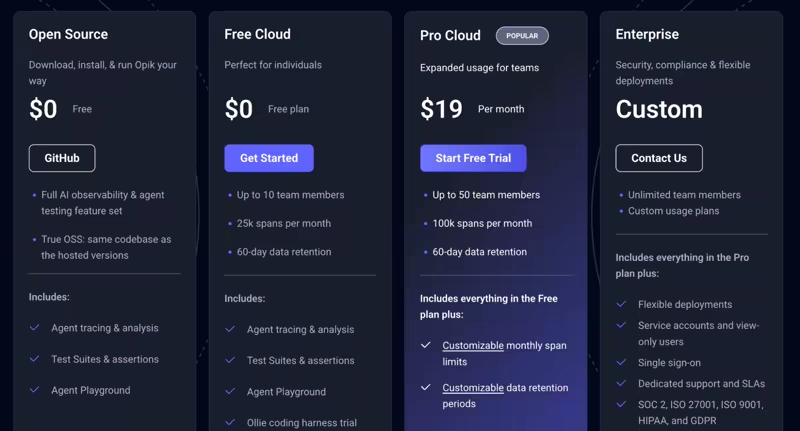
Opik is open-source and free to use. Its cloud plan starts free for up to 10 team members and 25,000 spans per month, plus two paid plans:
- Pro: $19 per month
- Enterprise: Custom pricing
Read our detailed guide on the best Comet alternatives.
Pros and Cons
Opik undercuts Braintrust on price and openness. Its $19 plan sits far below Braintrust Pro, and the Apache 2.0 edition includes tracing, tests, playgrounds, and evals. Built-in test rules add pass or fail gates without forcing teams to write every metric.
The trade-off is that key governance features, like SSO, RBAC, and compliance reports are gated behind Enterprise. Span billing is cheaper than Braintrust’s two-part meter, but multi-agent systems can still produce large span counts.
6. MLflow 3
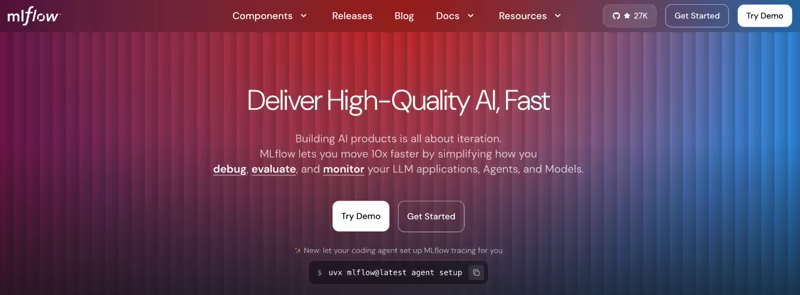
MLflow 3 is an Apache 2.0 project under the Linux Foundation and one of the most widely used open-source ML platforms. It now ships production tracing, evaluation, and prompt management alongside the experiment tracking and model registry that ML teams already run.
Features
- Capture agent and LLM activity through OpenTelemetry while keeping traces portable. MLflow records prompts, retrievals, tool calls, model responses, sessions, token use, cost, and more inside the same tracking server.
- Evaluate GenAI outputs with built-in metrics and LLM judges, then version prompts in a registry. Eval data stays close to the models and experiments it belongs to, so you can see where a prompt was used and how it performed.
- Route provider access through the AI Gateway so application code does not need separate provider keys. You can manage endpoints, traffic splitting, fallbacks, budgets, and request logs from one shared service.
- Keep classical ML and agent work in one platform if your organization already runs MLflow. Agents can use the same tracking server instead of adding a dedicated observability vendor.
Pricing
MLflow is open source and free to use under Apache 2.0 license. A managed offering exists through Databricks for teams that want it hosted.
Read our detailed guide on the best MLflow alternatives.
Pros and Cons
MLflow 3 is the safest choice if you care about open formats and low vendor lock-in. Apache 2.0 licensing, Linux Foundation governance, OpenTelemetry support, and no license fee make it attractive for long-term use.
The limitation is focus. MLflow is a broad platform, so some agent-specific workflows feel less polished than they do in dedicated tools. Without Databricks, your team also operates the tracking server, artifact store, and backend database.
7. Weights & Biases Weave
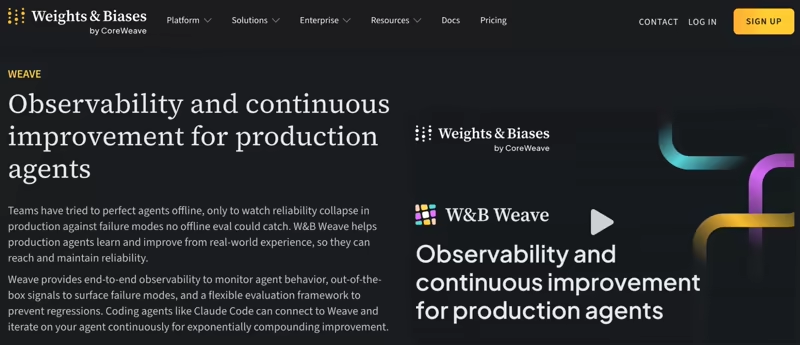
W&B Weave is the LLM observability layer of Weights & Biases. Its current trace model treats sessions, turns, steps, tools, and sub-agents as first-class concepts. That structure fits long conversations better than a flat list of unrelated spans.
Features
- Trace multi-turn, multi-agent sessions through sessions, turns, steps, tools, and sub-agents. This lets you debug at the session or turn level without losing the conversation and agent context around it.
- Score runs with pre-built evaluators for hallucination, toxicity, bias, PII, context relevance, coherence, and other quality or safety checks. You can compare results across runs and group them into leaderboards.
- Catch production issues with monitors that track quality or safety signals across live traces. You can also send alerts to Slack or webhooks when a monitor crosses a threshold.
- Stay inside the W&B ecosystem if your ML team already uses it. Experiment tracking, model registry, prompt work, tracing, and evals can all live under the same account.
Pricing
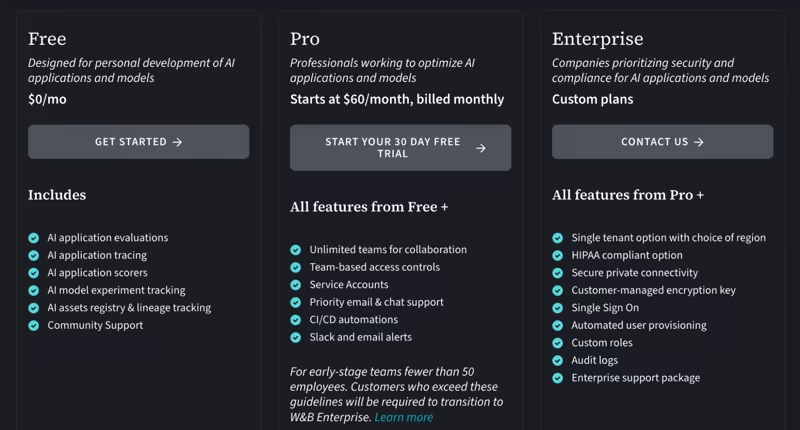
W&B offers a free plan and two paid plans:
- Pro: $60 per month
- Enterprise: Custom pricing
Read our detailed guide on the best Weights & Biases alternatives.
Pros and Cons
Weave’s agent-native trace model is a real answer to the span-list complaint that follows Braintrust around. If you already pay for W&B, you get the whole tracing and scoring stack for the price of enabling it.
But watch the cost meter. Weave bills by ingested data like Braintrust does, and at $0.10 per MB Weave’s overage rate is steep. Verbose agent traces can burn through the allowance quickly. Custom retention also sits on Enterprise, which brings you to the very problem you may be trying to leave.
8. Confident AI (DeepEval)
Confident AI is the evaluation platform built by the team behind DeepEval, an Apache 2.0 framework with more than 17,000 GitHub stars. It is eval-first, dataset-centric, and built around regression testing.
Features
- Write LLM and agent tests in Python with DeepEval’s pytest-style API. Engineers can keep quality checks beside application tests, run them locally, and add them to CI before a prompt or model update ships.
- Score both individual responses and full conversations with metrics for relevance, hallucination, task completion, tool use, and multi-turn quality. Custom criteria let you test product rules that the standard metric library does not cover.
- Turn production failures into regression tests by saving traces as datasets. You can rerun the same cases after a change and compare pass rates before deciding whether the update is safe to release.
- Simulate and review conversations through chat simulations. Annotation queues then let human reviewers inspect selected outputs, add scores, and feed useful examples back into the evaluation set.
Pricing
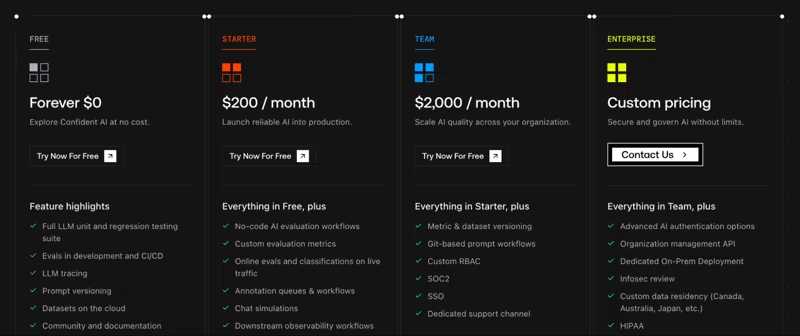
Confident AI’s free tier includes 5 test runs per week, 1 GB-month of trace spans, 2 seats, and 1 project. For scale, it offers three paid plans:
- Starter: $200 per month
- Team: $2000 per month
- Enterprise: Custom pricing
Read our detailed guide on the best DeepEval alternatives.
Pros and Cons
Confident AI keeps Braintrust’s eval-first strengths while adding an Apache 2.0 test framework. The unit-test model fits engineering teams that want regression checks close to the code.
The pricing ladder has its own gap, though. After the $200 Starter tier, the Team plan jumps to $2,000. Self-hosting the platform is Enterprise-only, and span storage is GB-metered, so the cost dynamics of verbose agent traces still apply.
The Best Braintrust Alternatives for AI Agent Observability
There is no single best Braintrust alternative. The right pick depends on what pushed you away from Braintrust in the first place.
- Kitaru by ZenML is best when you want to re-run production sessions against recorded tool history and compare data across cohorts without leaving your environment.
- Langfuse is best when you want the closest like-for-like replacement for Braintrust, with an MIT-licensed core and a lower-cost paid tier.
- Arize Phoenix is best when OpenTelemetry portability is non-negotiable and you want traces that are easier to move later.
A useful question across all eight tools is where your traces, provider credentials, and test data live, and how much control you have over moving or hosting them. Braintrust’s May incident made that question harder to ignore.
That is where Kitaru fits. It sits beside your agent runtime, records or imports complete sessions, and re-executes candidate code against controlled tool history. Versioned evaluators and fixed cohorts turn those sessions into repeatable experiments before a change ships.
If that sounds like the evaluation loop you need, star Kitaru on GitHub, read the docs, or book a demo today!