















Choosing a sandbox runtime for long-lived coding agents
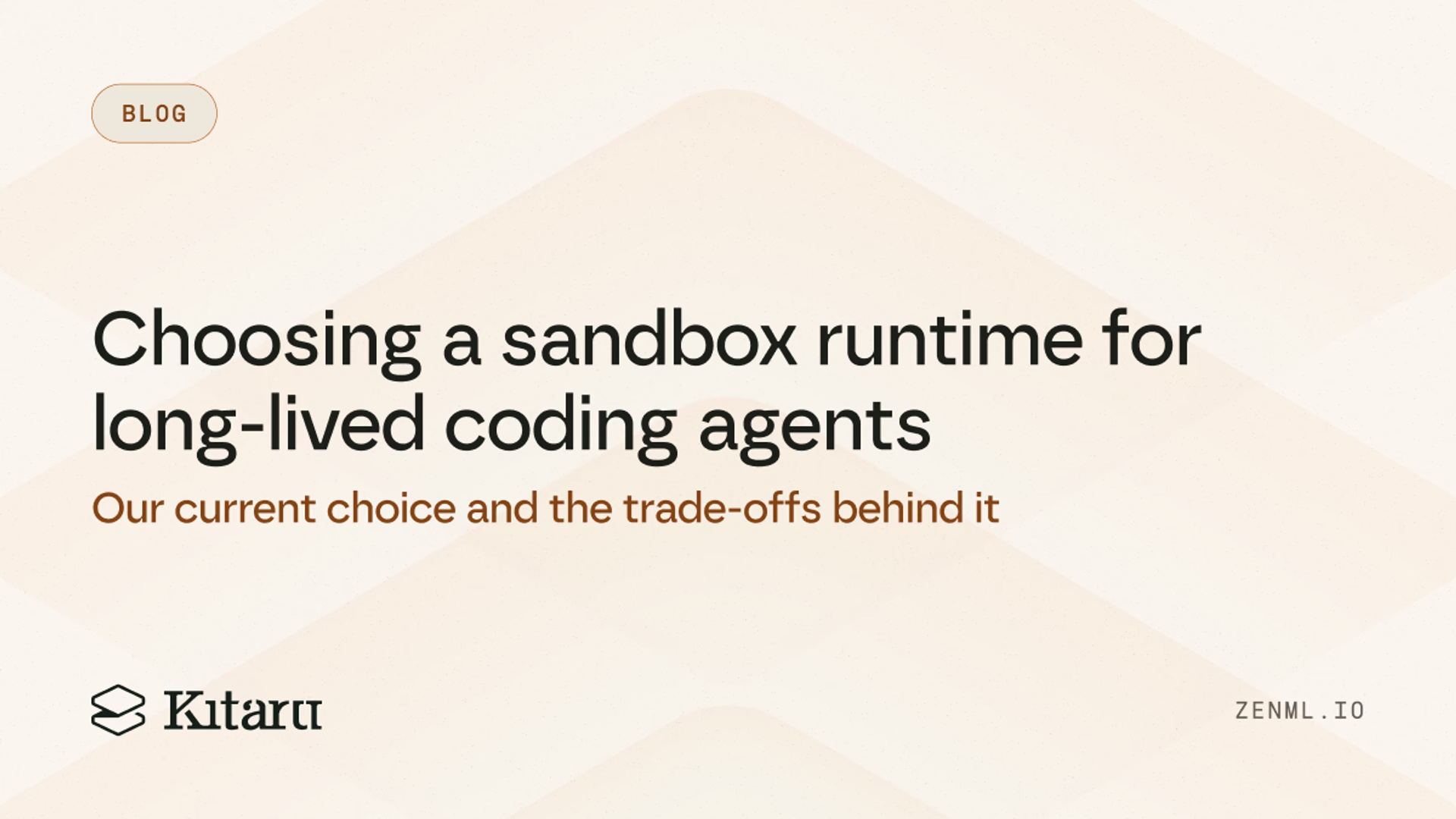
How we evaluated sandbox providers for coding agents, what we chose for now, and the trade-offs behind that decision.
orchestrators
Discover how ZenML compares to Flyte in the realm of machine learning workflow orchestration. While both tools aim to streamline and automate ML pipelines, ZenML distinguishes itself with its agile and lightweight approach, empowering data scientists and ML engineers to iterate quickly and efficiently. With ZenML's intuitive pipeline definition, seamless integration with MLOps tools, and strong focus on simplicity and usability, you can accelerate your ML workflows and spend more time on what matters most: building innovative ML solutions. Explore ZenML's unique features and benefits, and learn how it can help you navigate the complexities of MLOps with ease.
| Feature | ZenML | Flyte |
|---|---|---|
| Pipeline Definition | Yes Intuitive Python-based DSL for defining ML pipelines | Yes Declarative approach using Python annotations |
| Task Orchestration | Yes Flexible orchestration of heterogeneous tasks | Yes Orchestrates tasks across multiple platforms |
| Experiment Tracking | Yes Seamless integration with MLflow and other experiment tracking tools | Yes Supports MLflow integration for experiment tracking |
| Model Registry | Yes Built-in model registry for versioning and serving models | Not supported Relies on external model registry solutions |
| Data Versioning | Yes Integrates with data versioning tools like DVC and Pachyderm | Not supported No built-in data versioning capabilities |
| Workflow Scheduling | Yes Supports scheduled execution of ML workflows | Yes Provides workflow scheduling and triggering |
| Cloud Agnostic | Yes Runs on any cloud platform or on-premise infrastructure | Yes Supports multiple cloud platforms and Kubernetes |
| Extensibility | Yes Highly extensible with plugins and custom integrations | Yes Allows custom plugins and extensions |
| Community and Ecosystem | Yes Growing community and ecosystem around ZenML | Yes Mature community and industry adoption |
| Learning Curve | Yes Gentle learning curve and beginner-friendly | Not supported Steeper learning curve compared to ZenML |
Code comparison
from zenml import pipeline, step
from zenml.integrations import mlflow

@step
def preprocess_data(data):
    # Preprocess the data
    preprocessed_data = ...
    return preprocessed_data

@step
def train_model(preprocessed_data):
    # Train the model
    model = ...
    mlflow.log_model(model, "model")
    return model

@step
def evaluate_model(model, test_data):
    # Evaluate the model
    metrics = ...
    mlflow.log_metrics(metrics)
    return metrics

@pipeline
def ml_pipeline(data, test_data):
    preprocessed_data = preprocess_data(data)
    model = train_model(preprocessed_data)
    metrics = evaluate_model(model, test_data)

# Run the pipeline
ml_pipeline(data, test_data)from flytekit import task, workflow
from flytekit.extras.sqlite3.task import SQLite3Task
@task
def preprocess_data(data: str) -> str:
# Preprocess the data
preprocessed_data = ...
return preprocessed_data
@task
def train_model(preprocessed_data: str) -> str:
# Train the model
model = ...
return model
@task
def evaluate_model(model: str, test_data: str) -> dict:
# Evaluate the model
metrics = ...
return metrics
@workflow
def ml_workflow(data: str, test_data: str) -> dict:
preprocessed_data = preprocess_data(data=data)
model = train_model(preprocessed_data=preprocessed_data)
metrics = evaluate_model(model=model, test_data=test_data)
return metrics
# Execute the workflow
ml_workflow(data="input_data", test_data="test_data")ZenML's lightweight and flexible pipeline definition enables rapid iteration and experimentation, allowing data scientists and ML engineers to quickly prototype and refine ML workflows using a familiar Python-based syntax.
With ZenML's out-of-the-box integrations and pre-built extensions, you can easily connect your ML workflows with popular MLOps tools and platforms, streamlining your end-to-end MLOps processes.
ZenML prioritizes simplicity and ease of use, providing comprehensive documentation, tutorials, and community support to facilitate faster adoption and productivity for teams of all skill levels.
ZenML offers a built-in model registry for versioning and serving models, as well as seamless integration with data versioning tools like DVC and Pachyderm, ensuring reproducibility and traceability of your ML workflows.
Compared to Flyte, ZenML has a gentler learning curve and is more beginner-friendly, enabling faster onboarding and adoption within your organization.
Orchestrator Showdown

ML-optimized workflow management. Enhance scalability and usability with comprehensive features designed for ML pipeline orchestration.

ZenML is an open-source alternative to Argo Workflows for ML pipelines with built-in metadata, lineage, and reproducibility

Dagster alternative: Streamline ML ops with intuitive pipelines. Seamless integrations and experiment tracking for efficient ML workflow management.
Databricks alternative: Flexible ML orchestration without vendor lock-in. Accelerate ML with lightweight, adaptable workflows across multiple clouds.

Kedro alternative: Scalable, user-friendly ML framework. Streamline operations with robust features for efficient project management and deployment.

Kubeflow alternative: Lightweight ML pipeline management. Simplify MLOps with flexible, user-friendly workflows across various environments.

Prefect alternative: ML-centric pipeline orchestration. Streamline workflows with intuitive design, experiment tracking, and MLOps integrations.
How we evaluated sandbox providers for coding agents, what we chose for now, and the trade-offs behind that decision.
The new Kitaru turns production traces you already collect into replayable test scenarios, expert-reviewed cohorts, and evaluators you can run on every change.
Robotics compute is spreading across clouds and clusters. Learn how one portable pipeline layer can keep the robot-learning loop reproducible.
Iterate quickly and efficiently with ZenML's intuitive Python-based pipeline definition Streamline your MLOps processes with ZenML's out-of-the-box integrations and extensions Benefit from ZenML's built-in model registry and data versioning capabilities for reproducible and traceable workflows Experience faster adoption and productivity with ZenML's beginner-friendly design and comprehensive resources