ZenML
Blog From POC to Production: A Guide to Scaling Retail MLOps Infrastructure
MLOps 2 mins

From POC to Production: A Guide to Scaling Retail MLOps Infrastructure

Discover how successful retail organizations navigate the complex journey from proof-of-concept to production-ready MLOps infrastructure. This comprehensive guide explores essential strategies for scaling machine learning operations, covering everything from standardized pipeline architecture to advanced model management. Learn practical solutions for handling model proliferation, managing multiple environments, and implementing robust governance frameworks. Whether you're dealing with a growing model fleet or planning for future scaling challenges, this post provides actionable insights for building sustainable, enterprise-grade MLOps systems in retail.

From POC to Production: A Guide to Scaling Retail MLOps Infrastructure
On this page

Scaling MLOps: From Proof of Concept to Production in Retail Forecasting

In the fast-paced world of retail analytics, the journey from running a single proof-of-concept machine learning model to deploying dozens of production models is filled with interesting challenges. This post explores common hurdles organizations face when scaling their ML operations and offers practical solutions for building robust, scalable MLOps infrastructure.

The Challenge of Model Proliferation

As businesses grow and acquire more customers, the need for specialized ML models often grows exponentially. What starts as a simple forecasting model for one retail location can quickly evolve into a requirement for dozens or even hundreds of customer-specific models. This proliferation introduces several key challenges:

  • Infrastructure Scaling: Moving from local development to production-grade infrastructure
  • Model Management: Tracking and organizing multiple model versions across customers
  • Deployment Workflows: Standardizing the process of moving models from development to production
  • Resource Optimization: Balancing computational resources across multiple training pipelines

Building a Scalable MLOps Foundation

Standardized Pipeline Architecture

The key to handling multiple customer-specific models lies in creating a standardized, reusable pipeline architecture. Instead of building separate pipelines for each customer, focus on creating a single, configurable pipeline that can:

  • Accept different customer data sources
  • Handle varying data schemas and formats
  • Produce customer-specific models
  • Maintain isolation between different customer contexts
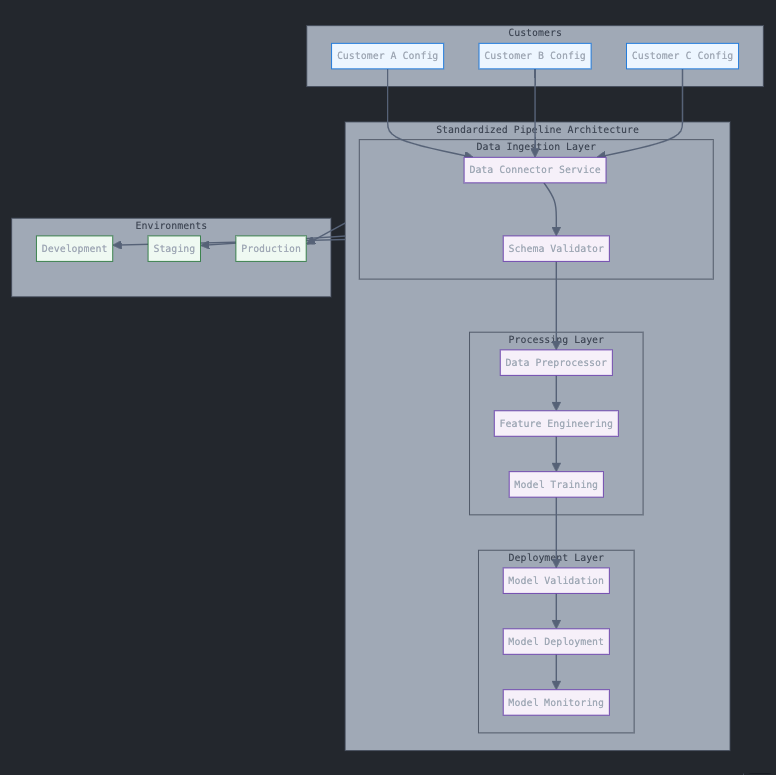
Flowchart depicting a standardized MLOps pipeline. Multiple customer configurations (A, B, C) feed into a single pipeline with three layers: Data Ingestion, Processing, and Deployment. The pipeline outputs to Development, Staging, and Production environments, showing how one architecture handles multiple customer needs.

Environment Management Strategy

When scaling MLOps across different environments (development, staging, production), consider these best practices:

  1. Infrastructure Separation: Maintain distinct clusters for production and non-production workloads
  2. Configuration Management: Use environment-specific configurations while keeping pipeline code consistent
  3. Access Control: Implement proper RBAC and security measures across environments
  4. Artifact Management: Establish clear policies for model artifact promotion across environments

Advanced Model Management Considerations

As your model fleet grows, consider implementing these management strategies:

Version Control and Tagging

Implement a robust versioning system that includes:

  • Semantic versioning for models
  • Environment-specific tags (dev, staging, prod)
  • Customer-specific identifiers
  • Performance metadata

Automated Model Lifecycle

Create automated workflows for:

  • Model training and validation
  • A/B testing new versions
  • Promotion between environments
  • Performance monitoring
  • Rollback procedures

Future-Proofing Your MLOps Stack

Organizations need to think ahead about:

  1. Scalability: Building infrastructure that can handle 10x current capacity
  2. Monitoring: Implementing comprehensive observability across all models
  3. Governance: Establishing clear policies for model deployment and updates
  4. Resource Management: Optimizing computing resources across multiple training jobs
Boromir - LotR meme with caption “One does not simply deploy ML models to production”

Conclusion

Scaling MLOps from a single model to dozens of production models requires careful planning and robust infrastructure. The key is building standardized, repeatable processes while maintaining flexibility for customer-specific requirements. Focus on creating strong foundations in pipeline architecture, environment management, and model governance to support sustainable growth.

As the field continues to evolve, organizations must stay adaptable while maintaining operational excellence. The investment in proper MLOps infrastructure today will pay dividends as ML operations continue to scale tomorrow.


Start deploying AI workflows in production today

Enterprise-grade AI platform trusted by thousands of companies in production

Continue Reading

Bridging the MLOps Divide: From Research Papers to Production Ai

Bridging the MLOps Divide: From Research Papers to Production Ai

Discover how organizations can successfully bridge the gap between academic machine learning research and production-ready AI systems. This comprehensive guide explores the cultural and technical challenges of transitioning from research-focused ML to robust production environments, offering practical strategies for implementing effective MLOps practices from day one. Learn how to avoid common pitfalls, manage technical debt, and build a sustainable ML engineering culture that combines academic innovation with production reliability.

From Legacy to Leading Edge: A Guide to MLOps Platform Modernization

From Legacy to Leading Edge: A Guide to MLOps Platform Modernization

Discover how leading organizations are successfully transitioning from legacy ML infrastructure to modern, scalable MLOps platforms. This comprehensive guide explores critical challenges in ML platform modernization, including migration strategies, security considerations, and the integration of emerging LLM capabilities. Learn proven best practices for evaluating modern platforms, managing complex transitions, and ensuring long-term success in your ML operations. Whether you're dealing with technical debt in custom solutions or looking to scale your ML capabilities, this article provides actionable insights for a smooth modernization journey.

Bridging the Gap: How Modern MLOps Platforms Serve Both Citizen Data Scientists and ML Engineers

Bridging the Gap: How Modern MLOps Platforms Serve Both Citizen Data Scientists and ML Engineers

Discover how modern MLOps platforms are evolving to bridge the gap between citizen data scientists and ML engineers, tackling the complex challenge of serving both technical and non-technical users. This analysis explores the hidden costs of DIY platform building, infrastructure abstraction challenges, and the emerging solutions that enable seamless collaboration while maintaining governance and efficiency. Learn why the future of MLOps lies not in one-size-fits-all approaches, but in flexible, modular architectures that empower both personas to excel in their roles.