





















Choosing a sandbox runtime for long-lived coding agents
How we evaluated sandbox providers for coding agents, what we chose for now, and the trade-offs behind that decision.
e2e-platforms
Azure ML bundles pipelines, endpoints, registries, and monitoring into a single Azure-native suite. ZenML provides similar lifecycle controls while keeping your orchestration portable across AWS, GCP, Azure, and on-prem. If you're evaluating Azure ML for enterprise MLOps but want an exit strategy or a multi-cloud operating model, ZenML is the open-source alternative designed for that reality.
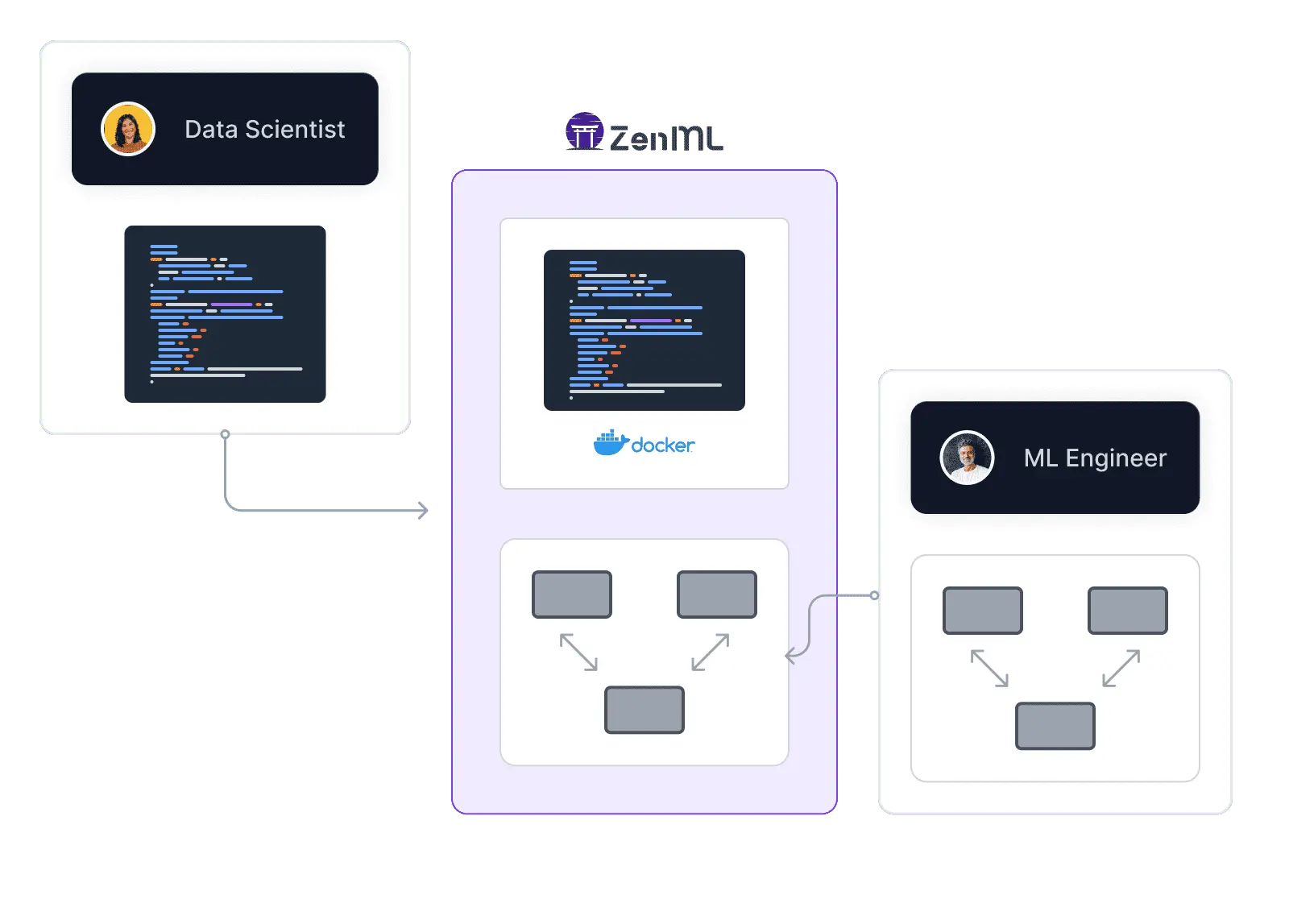

ZenML has proven to be a critical asset in our machine learning toolbox, and we are excited to continue leveraging its capabilities to drive ADEO's machine learning initiatives to new heights

François Serra
ML Engineer / ML Ops / ML Solution architect at ADEO Services
| Feature | ZenML | Azure ML |
|---|---|---|
| Workflow Orchestration | Yes Purpose-built ML pipeline orchestration with pluggable backends — Airflow, Kubeflow, Kubernetes, and more |
Yes First-class DAG pipelines built from versioned components with UI, CLI, and SDK authoring plus built-in scheduling within Azure |
| Integration Flexibility | Yes Composable stack with 50+ MLOps integrations — swap orchestrators, trackers, and deployers without code changes |
Not supported Integrates well with Azure-native services and supports MLflow, but not built as a neutral integration hub for non-Azure tools |
| Vendor Lock-In | Yes Open-source Python pipelines run anywhere — switch clouds, orchestrators, or tools without rewriting code |
Not supported Fundamentally an Azure service — Arc-enabled K8s extends compute reach but governance and asset control remain tied to Azure workspaces |
| Setup Complexity | Yes pip install zenml — start building pipelines in minutes with zero infrastructure, scale when ready |
Not supported Initial setup requires workspace provisioning, IAM/RBAC, networking, and dependent Azure services like Storage, ACR, and Key Vault |
| Learning Curve | Yes Python-native API with decorators — familiar to any ML engineer or data scientist who writes Python |
Not supported Broad concept set (assets, resources, components, jobs, endpoints, registries) plus v1/v2 ecosystem fragmentation slows time-to-productivity |
| Scalability | Yes Delegates compute to scalable backends — Kubernetes, Spark, cloud ML services — for unlimited horizontal scaling |
Yes Enterprise-scale managed training and inference on Azure compute, plus hybrid Kubernetes compute targets for large regulated deployments |
| Cost Model | Yes Open-source core is free — pay only for your own infrastructure, with optional managed cloud for enterprise features |
Not supported No separate platform fee, but total cost includes compute plus multiple Azure services (Storage, ACR, Key Vault, monitoring) that can be hard to predict |
| Collaboration | Yes Code-native collaboration through Git, CI/CD, and code review — ZenML Pro adds RBAC, workspaces, and team dashboards |
Yes Workspaces, registries, and Azure RBAC make collaboration first-class — assets can be centrally managed and replicated across regions |
| ML Frameworks | Yes Use any Python ML framework — TensorFlow, PyTorch, scikit-learn, XGBoost, LightGBM — with native materializers and tracking |
Yes Supports broad ML/DL workflows including no-code AutoML options and arbitrary training routines packaged as components or jobs |
| Monitoring | Yes Integrates Evidently, WhyLogs, and other monitoring tools as stack components for automated drift detection and alerting |
Yes Deep Azure Monitor integration for endpoint metrics and logs, plus model monitoring with data drift signals and alerting via Event Grid |
| Governance | Yes ZenML Pro provides RBAC, SSO, workspaces, and audit trails — self-hosted option keeps all data in your own infrastructure |
Yes Inherits Azure's enterprise governance model with RBAC, managed identities, registries with fine-grained permissions, and centralized asset management |
| Experiment Tracking | Yes Native metadata tracking plus seamless integration with MLflow, Weights & Biases, Neptune, and Comet for rich experiment comparison |
Yes MLflow-compatible workspaces with automatic job metadata tracking — Azure ML recommends MLflow for metrics and params logging |
| Reproducibility | Yes Automatic artifact versioning, code-to-Git linking, and containerized execution guarantee reproducible pipeline runs |
Yes Jobs automatically track code, environment, and inputs/outputs — versioned components and registries enable durable asset reuse across workspaces |
| Auto-Retraining | Yes Schedule pipelines via any orchestrator or use ZenML Pro event triggers for drift-based automated retraining workflows |
Yes Supports scheduling pipeline jobs for routine retraining via UI, CLI, and SDK — though v2 schedules do not support event-based triggers |
Code comparison
from zenml import pipeline, step, Model
from zenml.integrations.mlflow.steps import (
    mlflow_model_deployer_step,
)
import pandas as pd
from sklearn.ensemble import RandomForestRegressor
from sklearn.metrics import mean_squared_error
import numpy as np

@step
def ingest_data() -> pd.DataFrame:
    return pd.read_csv("data/dataset.csv")

@step
def train_model(df: pd.DataFrame) -> RandomForestRegressor:
    X, y = df.drop("target", axis=1), df["target"]
    model = RandomForestRegressor(n_estimators=100)
    model.fit(X, y)
    return model

@step
def evaluate(model: RandomForestRegressor, df: pd.DataFrame) -> float:
    X, y = df.drop("target", axis=1), df["target"]
    preds = model.predict(X)
    return float(np.sqrt(mean_squared_error(y, preds)))

@step
def check_drift(df: pd.DataFrame) -> bool:
    # Plug in Evidently, Great Expectations, etc.
    return detect_drift(df)

@pipeline(model=Model(name="my_model"))
def ml_pipeline():
    df = ingest_data()
    model = train_model(df)
    rmse = evaluate(model, df)
    drift = check_drift(df)

# Runs on any orchestrator, logs to MLflow,
# tracks artifacts, and triggers retraining — all
# in one portable, version-controlled pipeline
ml_pipeline()from azure.identity import DefaultAzureCredential
from azure.ai.ml import MLClient, Input, dsl, load_component
credential = DefaultAzureCredential()
ml_client = MLClient(
credential=credential,
subscription_id=SUBSCRIPTION,
resource_group_name=RESOURCE_GROUP,
workspace_name=WORKSPACE,
)
credit_data = ml_client.data.get(name="credit-card", version="1")
prep = load_component(source="./components/data_prep.yml")
train = load_component(source="./components/train.yml")
@dsl.pipeline(compute="serverless", description="Prep + train")
def training_pipeline(data_input, test_ratio: float, model_name: str):
prep_job = prep(data=data_input, test_train_ratio=test_ratio)
train_job = train(
train_data=prep_job.outputs.train_data,
test_data=prep_job.outputs.test_data,
registered_model_name=model_name,
)
return {"model": train_job.outputs.model_output}
pipeline_job = training_pipeline(
data_input=Input(type="uri_file", path=credit_data.path),
test_ratio=0.25,
model_name="credit_defaults_model",
)
submitted = ml_client.jobs.create_or_update(
pipeline_job, experiment_name="credit-defaults"
)
ml_client.jobs.stream(submitted.name)
# Requires Azure subscription, workspace, IAM config.
# Pipelines tied to Azure ML workspace control plane.
# v1 SDK deprecated — must use v2 (azure-ai-ml).ZenML is fully open-source and vendor-neutral, letting you avoid the significant licensing costs and platform lock-in of proprietary enterprise platforms. Your pipelines remain portable across any infrastructure, from local development to multi-cloud production.
ZenML offers a pip-installable, Python-first approach that lets you start locally and scale later. No enterprise deployment, platform operators, or Kubernetes clusters required to begin — build production-grade ML pipelines in minutes, not weeks.
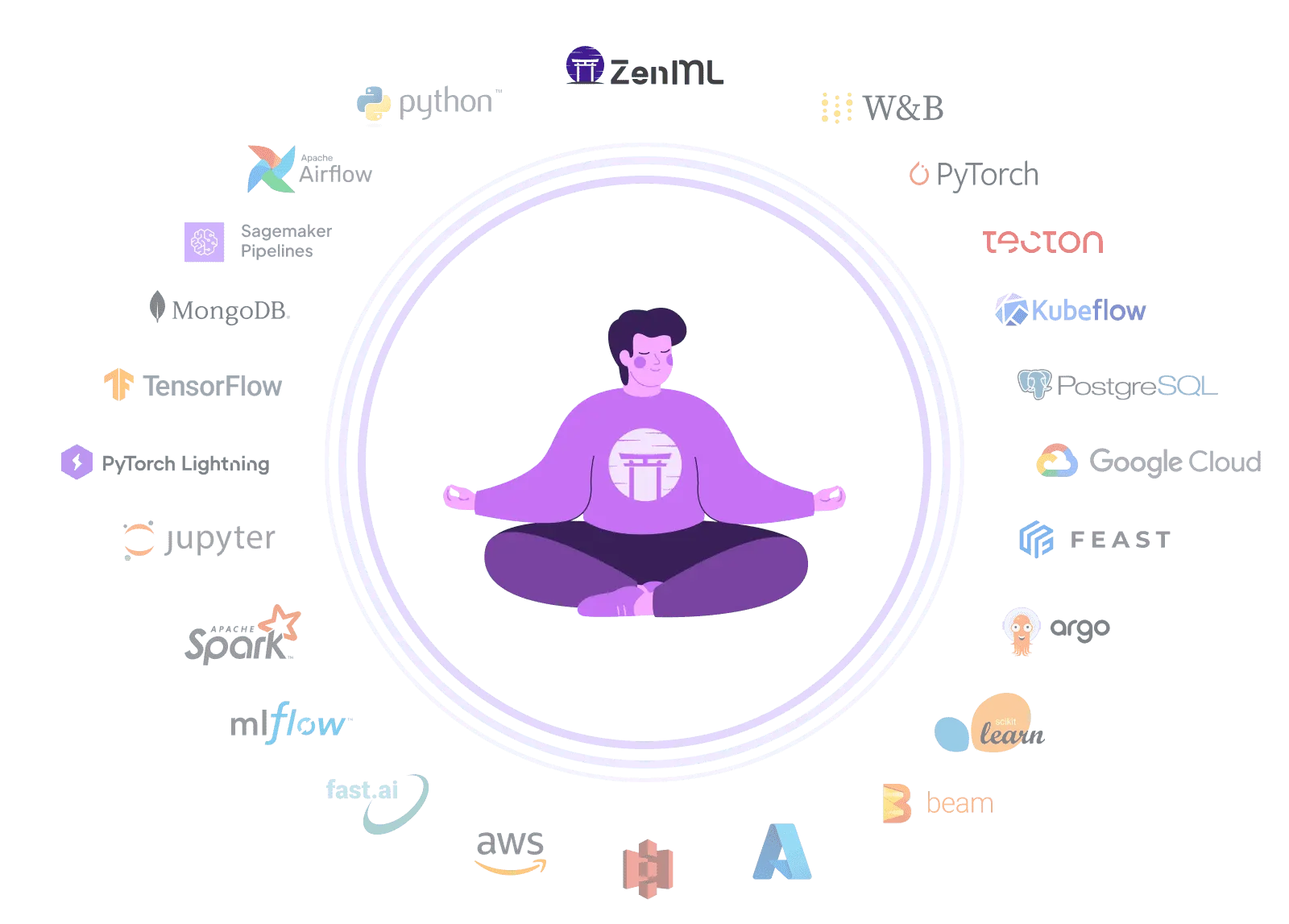
ZenML's composable stack lets you choose your own orchestrator, experiment tracker, artifact store, and deployer. Swap components freely without re-platforming — your pipelines adapt to your toolchain, not the other way around.
E2E Platform Showdown

Alteryx alternative for ML pipelines: open-source, code-first MLOps with vendor-neutral portability. Build production ML workflows that run anywhere
Vendor-neutral ML orchestration. Build, train, and deploy models across environments with flexible workflows and no cloud lock-in.

ClearML alternative: Flexible MLOps framework with extensive integrations. Accelerate ML development using adaptable architecture and reduced lock-in, while simplifying infrastructure setup.

Dataiku alternative: Open-source MLOps framework with portable Python pipelines and composable stack. Build production ML workflows with vendor-neutral flexibility and best-of-breed tool integration

Domino Data Lab alternative: Open-source MLOps framework with portable pipelines and composable stack. Build production ML workflows with vendor-neutral flexibility and code-first portability

Metaflow alternative: Flexible ML orchestration with comprehensive MLOps. Accelerate ML using adaptable architecture and seamless integrations.

Valohai alternative: Open-source MLOps framework with extensive integrations. Accelerate ML development using Python-based SDK, adaptable architecture, and existing infrastructure, while avoiding vendor lock-in.

ZenML: an open-source alternative to Vertex AI Pipelines that keeps your MLOps stack portable across GCP, AWS, Azure, and on-prem
How we evaluated sandbox providers for coding agents, what we chose for now, and the trade-offs behind that decision.
The new Kitaru turns production traces you already collect into replayable test scenarios, expert-reviewed cohorts, and evaluators you can run on every change.
Robotics compute is spreading across clouds and clusters. Learn how one portable pipeline layer can keep the robot-learning loop reproducible.
Explore how ZenML maps common Azure ML concepts like pipelines, components, and registries to a portable, cloud-agnostic stack Learn how to migrate gradually: keep Azure ML where it's strongest while standardizing pipeline logic for multi-cloud flexibility See real-world patterns for swapping orchestrators and backends without rewriting workflows as your organization grows