





























Choosing a sandbox runtime for long-lived coding agents
How we evaluated sandbox providers for coding agents, what we chose for now, and the trade-offs behind that decision.
model-serving
Seldon Core is a Kubernetes-native model serving framework for deploying, scaling, and operating inference workloads. ZenML is the upstream lifecycle layer that builds, tests, versions, and promotes models into production. Use it to orchestrate how models are created and validated, and use Seldon to run and monitor them at scale on Kubernetes.

ZenML has proven to be a critical asset in our machine learning toolbox, and we are excited to continue leveraging its capabilities to drive ADEO's machine learning initiatives to new heights

François Serra
ML Engineer / ML Ops / ML Solution architect at ADEO Services
| Feature | ZenML | Seldon Core |
|---|---|---|
| Workflow Orchestration | Yes ZenML is built for defining and running reproducible ML/AI pipelines end-to-end, with infrastructure abstracted behind swappable stacks. | Not supported Seldon Core focuses on model deployment and inference operations; it does not provide a native training/evaluation pipeline orchestrator. |
| Integration Flexibility | Yes ZenML's composable stack architecture lets teams plug in different orchestrators, artifact stores, experiment trackers, and deployers without rewriting pipeline code. | Yes Seldon Core supports multiple model frameworks and component styles (pre-packaged servers or language wrappers) and integrates deeply with the Kubernetes ecosystem. |
| Vendor Lock-In | Yes ZenML is cloud-agnostic and designed to avoid lock-in by separating pipeline code from infrastructure backends. | Not supported Seldon Core is Kubernetes-native and production use requires a commercial license (BSL), increasing platform and vendor dependency. |
| Setup Complexity | Yes ZenML can start locally and scale up by swapping stack components; teams can adopt orchestration and cloud components incrementally. | Not supported Seldon Core typically requires a Kubernetes cluster plus CRD/operator installation and gateway/ingress configuration, increasing time-to-first-value. |
| Learning Curve | Yes ZenML's Python-native pipeline abstractions reduce friction for ML engineers who want to productionize workflows without becoming Kubernetes experts. | Not supported Seldon Core's primary abstractions (CRDs, gateways, inference graphs, rollout configs) are powerful but require Kubernetes and production serving knowledge. |
| Scalability | Yes ZenML scales by delegating execution to orchestrators (Kubernetes, Airflow, Kubeflow, etc.) while keeping pipelines portable. | Yes Seldon Core is built for high-scale production inference on Kubernetes and explicitly targets large-scale model deployment and operations. |
| Cost Model | Yes ZenML offers a free OSS tier plus clearly published SaaS tiers, so teams can forecast cost as usage grows. | Not supported Seldon Core's production licensing is commercial (BSL for non-production only), and enterprise pricing is typically sales-led rather than self-serve. |
| Collaboration | Yes ZenML Pro adds collaboration primitives like workspaces, RBAC/SSO, and UI-based control planes for artifacts and models. | Not supported Core itself is mainly an operator/runtime; richer collaboration and governance experiences are part of Seldon's commercial platform. |
| ML Frameworks | Yes ZenML supports many ML/DL frameworks across the lifecycle by letting you compose training, evaluation, and deployment steps in Python. | Yes Seldon Core supports serving models from multiple ML frameworks and languages via pre-packaged servers and language wrappers. |
| Monitoring | Yes ZenML tracks artifacts, metadata, and lineage across pipeline runs so teams can diagnose issues and connect production behavior to training provenance. | Yes Seldon Core provides advanced metrics, request logging, canaries/A-B tests, and outlier/explainer components for production inference monitoring. |
| Governance | Yes ZenML provides lineage, metadata, and (in Pro) fine-grained RBAC/SSO that supports auditability and controlled promotion processes. | Not supported Core provides operational primitives, but governance (auditing, compliance controls) is part of Seldon's enterprise platform rather than the core runtime. |
| Experiment Tracking | Yes ZenML can integrate with experiment trackers and also ties experiments to reproducible pipelines and versioned artifacts. | Not supported Seldon Core's 'experiments' are deployment experimentation/rollouts, not offline experiment tracking of runs, params, and metrics. |
| Reproducibility | Yes ZenML emphasizes reproducibility via artifact/version tracking, metadata, and pipeline snapshots that help recreate environments and results. | Not supported Seldon Core makes deployments repeatable via Kubernetes resources, but doesn't natively reproduce the upstream training pipeline, datasets, and evaluation context. |
| Auto-Retraining | Yes ZenML is designed to automate retraining and promotion by scheduling pipelines, triggering on events, and integrating CI/CD-style checks. | Not supported Seldon Core can host and monitor models, but automated retraining typically requires an external orchestrator or pipeline system. |
Code comparison
from zenml import pipeline, step

@step
def load_data():
    # Load and preprocess your data
    ...
    return train_data, test_data

@step
def train_model(train_data):
    # Train using ANY ML framework
    ...
    return model

@step
def evaluate(model, test_data):
    # Evaluate and log metrics
    ...
    return metrics

@pipeline
def ml_pipeline():
    train, test = load_data()
    model = train_model(train)
evaluate(model, test)from seldon_core.seldon_client import SeldonClient
# Assumes a SeldonDeployment named "mymodel" exists in namespace "seldon"
# and is exposed via an Ambassador gateway on localhost:8003.
sc = SeldonClient(
deployment_name="mymodel",
namespace="seldon",
gateway="ambassador",
gateway_endpoint="localhost:8003",
client_return_type="dict",
)
try:
result = sc.predict(transport="rest")
except Exception:
result = sc.predict(transport="grpc")
print(result)ZenML is fully open-source and vendor-neutral, letting you avoid the significant licensing costs and platform lock-in of proprietary enterprise platforms. Your pipelines remain portable across any infrastructure, from local development to multi-cloud production.
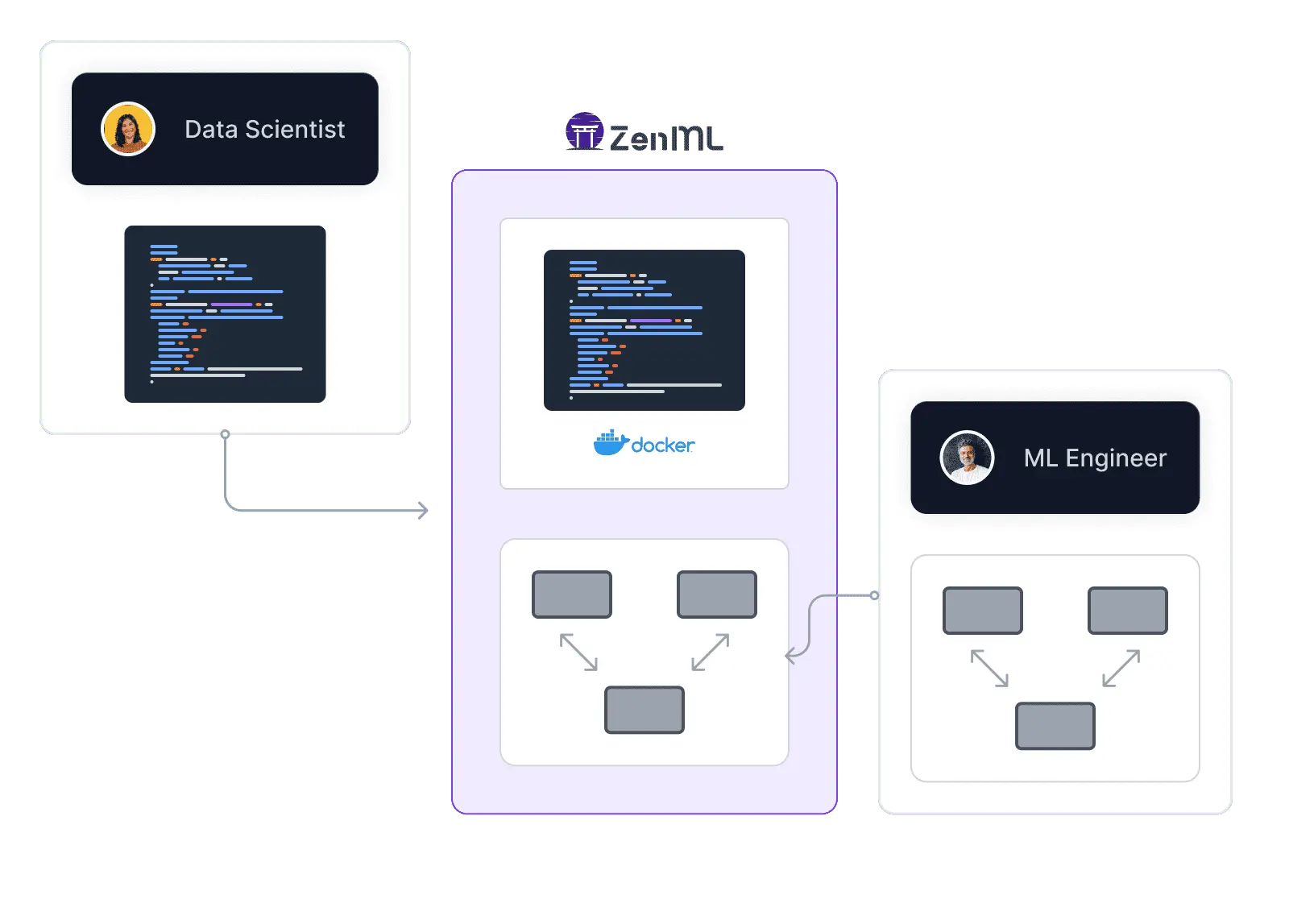
ZenML offers a pip-installable, Python-first approach that lets you start locally and scale later. No enterprise deployment, platform operators, or Kubernetes clusters required to begin — build production-grade ML pipelines in minutes, not weeks.
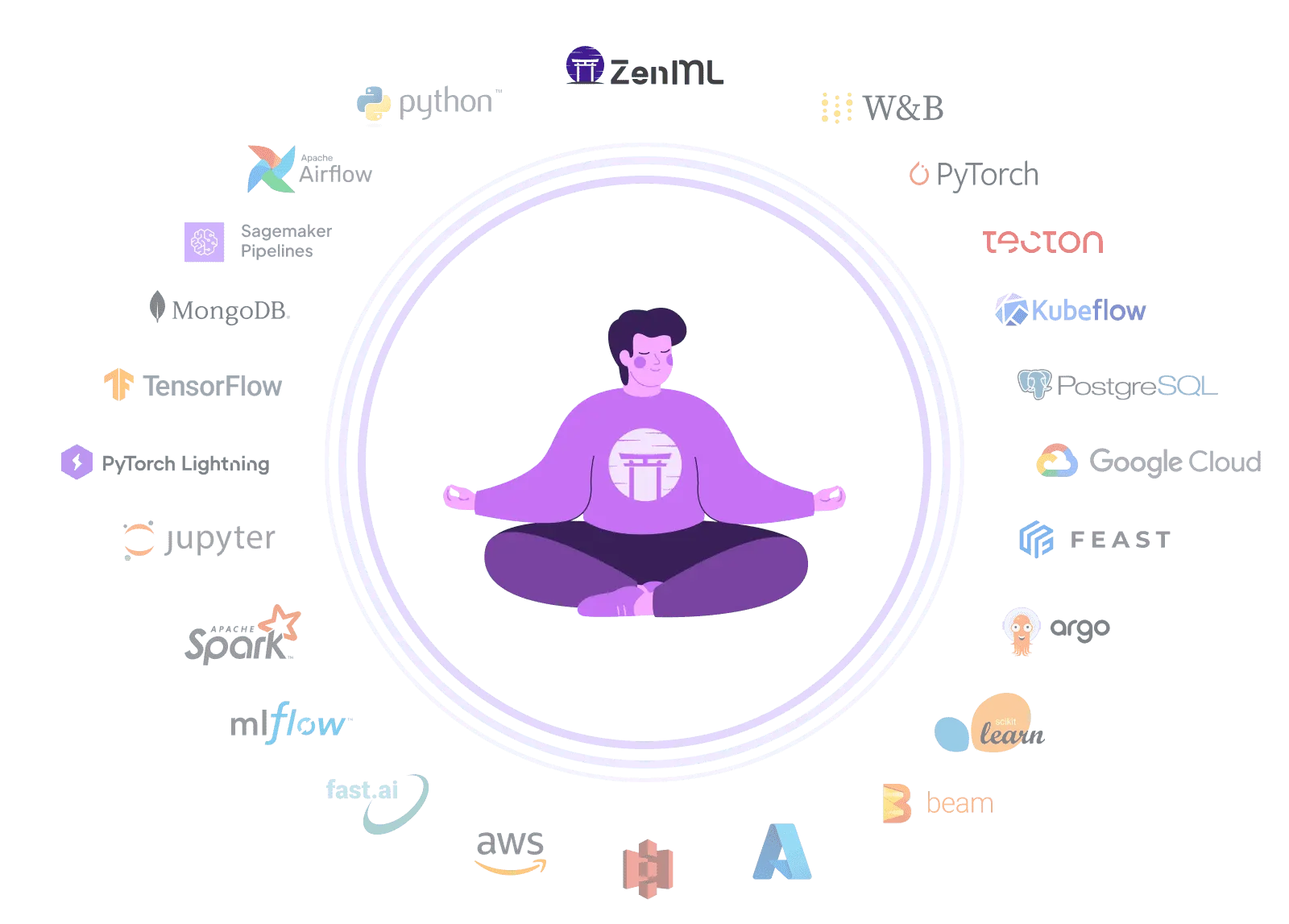
ZenML's composable stack lets you choose your own orchestrator, experiment tracker, artifact store, and deployer. Swap components freely without re-platforming — your pipelines adapt to your toolchain, not the other way around.
Tool Showdown
How we evaluated sandbox providers for coding agents, what we chose for now, and the trade-offs behind that decision.
The new Kitaru turns production traces you already collect into replayable test scenarios, expert-reviewed cohorts, and evaluators you can run on every change.
Robotics compute is spreading across clouds and clusters. Learn how one portable pipeline layer can keep the robot-learning loop reproducible.
Explore how ZenML pipelines can automate retraining, evaluation, and promotion before deploying a new model version to Kubernetes. Learn how ZenML Pro's snapshots and control planes help debug and govern what changed between model versions. See how ZenML's scheduling and triggers can turn production signals into retraining workflows for your serving stack.