ZenML
Blog Streamlining MLOps: A Manufacturing Success Blueprint from PoC to Production
MLOps 2 mins

Streamlining MLOps: A Manufacturing Success Blueprint from PoC to Production

Discover how manufacturing companies can successfully scale their machine learning operations from proof-of-concept to production. This comprehensive guide explores the three pillars of manufacturing AI, common MLOps challenges, and practical strategies for building a sustainable MLOps foundation. Learn how to overcome tool fragmentation, manage hybrid infrastructure, and implement effective collaboration practices across teams. Whether you're a data scientist, ML engineer, or manufacturing leader, this post provides actionable insights for creating a scalable, efficient MLOps practice that drives real business value.

Streamlining MLOps: A Manufacturing Success Blueprint from PoC to Production
On this page

Breaking Down MLOps Barriers in Manufacturing: A Journey from Proof of Concept to Production

In the manufacturing sector, the journey from implementing basic machine learning models to establishing a robust MLOps practice can feel like navigating a complex maze. As organizations move beyond proof-of-concept projects to production-ready AI systems, they face unique challenges that require careful consideration and strategic planning.

The Three Pillars of Manufacturing AI

Manufacturing companies typically focus on three core use cases when implementing AI:

  1. Predictive Maintenance: Anticipating when equipment needs maintenance or might fail
  2. Real-time Analytics: Monitoring machine health and performance metrics
  3. Model Predictive Control: Optimizing operational parameters like temperature control

While these use cases are well-defined, the path to implementing them at scale often reveals gaps between development and production environments.

Common MLOps Challenges in Manufacturing

Tool Fragmentation

Many organizations find themselves juggling multiple tools:

  • Jenkins for CI/CD
  • Custom solutions for continuous training
  • Cloud monitoring tools
  • Various model registries and artifact stores

This fragmentation creates cognitive overhead and makes it harder to maintain a cohesive MLOps strategy.

Infrastructure Complexity

Manufacturing environments often require flexibility between:

  • Cloud deployments
  • On-premises systems
  • Edge computing capabilities

This hybrid infrastructure needs careful orchestration to ensure models can be deployed and monitored effectively across different environments.

Building a Sustainable MLOps Foundation
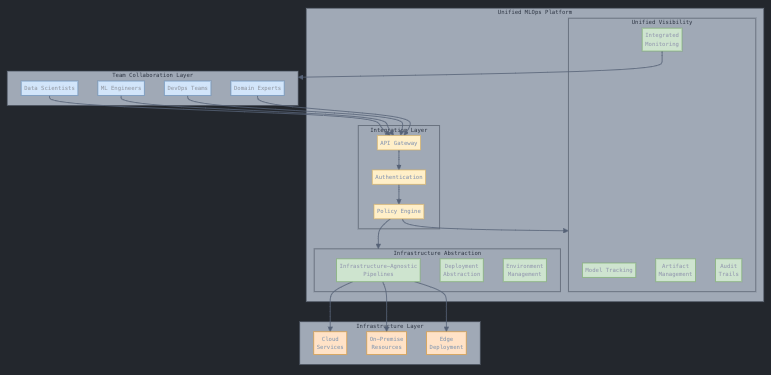
A hierarchical diagram illustrating a comprehensive MLOps platform architecture with four distinct layers. At the top, the Team Collaboration Layer shows four types of team members (Data Scientists, ML Engineers, DevOps Teams, and Domain Experts) connecting to the platform. The central Unified MLOps Platform layer is divided into three main sections: Infrastructure Abstraction (containing Pipeline, Deployment, and Environment Management components), Unified Visibility (featuring Model Tracking, Monitoring, Artifact Management, and Audit Trails), and an Integration Layer (with API Gateway, Authentication, and Policy Engine). At the bottom, the Infrastructure Layer shows three deployment options: Cloud Services, On-Premise Resources, and Edge Deployment. The diagram uses color coding to distinguish between layers: blue for teams, green for platform components, yellow for integration services, and orange for infrastructure. Arrows indicate data flow and interactions between components, with a feedback loop from monitoring back to teams. The architecture emphasizes how the platform provides abstraction while maintaining visibility and enabling collaboration across different teams and infrastructure types.

Rather than piecing together various tools manually, successful organizations are taking a more strategic approach:

1. Infrastructure Abstraction

  • Implement infrastructure-agnostic pipelines
  • Create clear separation between model logic and deployment details
  • Enable seamless transitions between development and production environments

2. Unified Visibility

Modern MLOps requires:

  • Centralized model tracking
  • Integrated monitoring solutions
  • Comprehensive artifact management
  • Clear audit trails for model versions and deployments

3. Team Collaboration

Effective MLOps in manufacturing requires close collaboration between:

  • Data Scientists
  • ML Engineers
  • DevOps Teams
  • Domain Experts

Looking Ahead: From PoC to Production

When evaluating MLOps solutions, organizations should consider:

  1. Scalability: How will the solution handle increasing model complexity and deployment frequency?
  2. Integration Capabilities: Can it work with existing tools and infrastructure?
  3. Cost Efficiency: What are the long-term operational costs?
  4. Time to Value: How quickly can teams go from development to production?

Conclusion

The transition from proof-of-concept to production-ready ML systems in manufacturing requires careful planning and the right tooling choices. While the challenges are significant, organizations that invest in building a solid MLOps foundation will be better positioned to scale their AI initiatives effectively.

The key is finding solutions that provide the right balance of flexibility and structure - allowing teams to use their preferred tools while maintaining a coherent, manageable MLOps practice that can grow with the organization’s needs.

Remember: The goal isn’t to have the most sophisticated MLOps setup from day one, but rather to build a foundation that can evolve with your organization’s growing AI maturity and changing needs.

Continue Reading

Bridging the MLOps Divide: From Research Papers to Production Ai

Bridging the MLOps Divide: From Research Papers to Production Ai

Discover how organizations can successfully bridge the gap between academic machine learning research and production-ready AI systems. This comprehensive guide explores the cultural and technical challenges of transitioning from research-focused ML to robust production environments, offering practical strategies for implementing effective MLOps practices from day one. Learn how to avoid common pitfalls, manage technical debt, and build a sustainable ML engineering culture that combines academic innovation with production reliability.

From Legacy to Leading Edge: A Guide to MLOps Platform Modernization

From Legacy to Leading Edge: A Guide to MLOps Platform Modernization

Discover how leading organizations are successfully transitioning from legacy ML infrastructure to modern, scalable MLOps platforms. This comprehensive guide explores critical challenges in ML platform modernization, including migration strategies, security considerations, and the integration of emerging LLM capabilities. Learn proven best practices for evaluating modern platforms, managing complex transitions, and ensuring long-term success in your ML operations. Whether you're dealing with technical debt in custom solutions or looking to scale your ML capabilities, this article provides actionable insights for a smooth modernization journey.

Bridging the Gap: How Modern MLOps Platforms Serve Both Citizen Data Scientists and ML Engineers

Bridging the Gap: How Modern MLOps Platforms Serve Both Citizen Data Scientists and ML Engineers

Discover how modern MLOps platforms are evolving to bridge the gap between citizen data scientists and ML engineers, tackling the complex challenge of serving both technical and non-technical users. This analysis explores the hidden costs of DIY platform building, infrastructure abstraction challenges, and the emerging solutions that enable seamless collaboration while maintaining governance and efficiency. Learn why the future of MLOps lies not in one-size-fits-all approaches, but in flexible, modular architectures that empower both personas to excel in their roles.