ZenML
Blog MLOps in Finance: A Strategic Guide to Scaling ML from Experiments to Production"
MLOps 2 mins

MLOps in Finance: A Strategic Guide to Scaling ML from Experiments to Production"

Discover how financial institutions can successfully transition their machine learning projects from experimental phases to robust production environments. This comprehensive guide explores critical challenges and strategic solutions in MLOps implementation, including regulatory compliance, team scaling, and infrastructure decisions. Learn practical approaches to building scalable ML systems while maintaining security and efficiency, with special focus on emerging technologies like RAG and their role in enterprise AI adoption. Perfect for ML practitioners, technical leaders, and decision-makers in the financial sector looking to scale their ML operations effectively.

MLOps in Finance: A Strategic Guide to Scaling ML from Experiments to Production"
On this page

From Experimentation to Production: Navigating the MLOps Journey in Financial Services

In the rapidly evolving landscape of machine learning operations, many organizations find themselves at a crucial crossroads: they’ve successfully experimented with ML models, but now face the challenge of scaling their operations while maintaining compliance and efficiency. This post explores common challenges and strategic considerations for teams transitioning from experimental ML projects to production-ready systems.

The Evolution of ML Team Dynamics

One of the most critical aspects of scaling ML operations is managing team growth and knowledge sharing. Many organizations start with a small, tight-knit team of ML practitioners who can “get by” with minimal MLOps infrastructure. However, as teams expand and new members join, the need for structured workflows and standardized processes becomes increasingly apparent.

Key considerations for growing ML teams include:

  • Establishing standardized onboarding processes for new team members
  • Creating clear documentation and knowledge sharing protocols
  • Implementing version control for both code and models
  • Defining clear roles and responsibilities within the ML pipeline

Regulatory Compliance in Financial ML
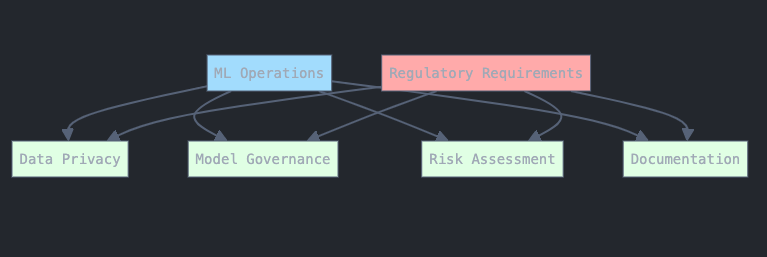
A diagram showing the intersection of Machine Learning Operations and Regulatory Requirements in financial services. Two main nodes, 'ML Operations' and 'Regulatory Requirements', each connect to four shared components: Data Privacy, Model Governance, Risk Assessment, and Documentation. The diagram uses a color scheme where ML Operations is shown in light blue, Regulatory Requirements in light red, and the shared components in light green, illustrating how these aspects must satisfy both operational and regulatory needs.

Financial services organizations face unique challenges when implementing ML systems, particularly regarding regulatory compliance and data privacy. While many companies are excited about the possibilities of Large Language Models (LLMs), careful consideration must be given to:

  • Data privacy requirements and regulatory frameworks
  • Model governance and auditability
  • Risk assessment and mitigation strategies
  • Documentation requirements for regulatory compliance

The RAG Approach: A Pragmatic Solution for Enterprise AI

Retrieval-Augmented Generation (RAG) has emerged as a practical approach for organizations looking to leverage AI capabilities while maintaining control over their data and operations. This approach offers several advantages:

  • Reduced dependency on external API providers
  • Better control over data privacy and security
  • Ability to incorporate domain-specific knowledge
  • More predictable operational costs

Scaling MLOps: When to Level Up Your Infrastructure

Many organizations struggle with determining the right time to invest in more sophisticated MLOps tools and infrastructure. Here are key indicators that it’s time to upgrade your MLOps stack:

  • Increased frequency of model training and deployment
  • Growing team size and complexity
  • Need for better model versioning and tracking
  • Requirements for enhanced collaboration and access control
  • Rising costs of manual operations and maintenance

Future-Proofing Your ML Infrastructure

As the ML landscape continues to evolve, organizations need to consider how their infrastructure choices today will impact their operations tomorrow. Key considerations include:

  • Cloud vendor independence
  • Scalability of chosen solutions
  • Flexibility to incorporate new technologies
  • Cost optimization strategies
  • Team growth and training requirements

Conclusion

The journey from experimental ML projects to production-ready systems is complex and multifaceted. Success requires careful consideration of team dynamics, regulatory requirements, and infrastructure choices. Organizations should focus on building flexible, scalable systems that can grow with their needs while maintaining compliance and operational efficiency.

Remember: The best time to invest in proper MLOps infrastructure isn’t when you’re already feeling the pain of scale - it’s when you can see that pain coming on the horizon.


Start deploying AI workflows in production today

Enterprise-grade AI platform trusted by thousands of companies in production

Continue Reading

Bridging the MLOps Divide: From Research Papers to Production Ai

Bridging the MLOps Divide: From Research Papers to Production Ai

Discover how organizations can successfully bridge the gap between academic machine learning research and production-ready AI systems. This comprehensive guide explores the cultural and technical challenges of transitioning from research-focused ML to robust production environments, offering practical strategies for implementing effective MLOps practices from day one. Learn how to avoid common pitfalls, manage technical debt, and build a sustainable ML engineering culture that combines academic innovation with production reliability.

From Legacy to Leading Edge: A Guide to MLOps Platform Modernization

From Legacy to Leading Edge: A Guide to MLOps Platform Modernization

Discover how leading organizations are successfully transitioning from legacy ML infrastructure to modern, scalable MLOps platforms. This comprehensive guide explores critical challenges in ML platform modernization, including migration strategies, security considerations, and the integration of emerging LLM capabilities. Learn proven best practices for evaluating modern platforms, managing complex transitions, and ensuring long-term success in your ML operations. Whether you're dealing with technical debt in custom solutions or looking to scale your ML capabilities, this article provides actionable insights for a smooth modernization journey.

Bridging the Gap: How Modern MLOps Platforms Serve Both Citizen Data Scientists and ML Engineers

Bridging the Gap: How Modern MLOps Platforms Serve Both Citizen Data Scientists and ML Engineers

Discover how modern MLOps platforms are evolving to bridge the gap between citizen data scientists and ML engineers, tackling the complex challenge of serving both technical and non-technical users. This analysis explores the hidden costs of DIY platform building, infrastructure abstraction challenges, and the emerging solutions that enable seamless collaboration while maintaining governance and efficiency. Learn why the future of MLOps lies not in one-size-fits-all approaches, but in flexible, modular architectures that empower both personas to excel in their roles.